
Hospitals manage hundreds or thousands of financial transactions every day, including outpatient consultations, inpatient admissions, laboratory investigations, pharmacy purchases, surgical procedures, insurance claims, and patient payments. Managing these activities manually can lead to billing errors, delayed payments, revenue leakage, and difficulties tracking outstanding balances.
Hospital billing software helps healthcare providers automate financial operations, generate accurate invoices, manage insurance claims, track payments, and monitor revenue across different departments. By connecting billing workflows with electronic medical records (EMR), hospital information systems (HIS), and revenue cycle management (RCM), hospitals can improve financial visibility and streamline daily operations.
In 2027, healthcare organizations need more than a basic invoicing solution. They need integrated billing technology that supports OPD, IPD, pharmacy, laboratory, insurance, and financial reporting in one connected environment.
Health Cluster provides integrated healthcare technology designed to help hospitals, clinics, and medical centers manage administrative, clinical, and financial workflows.
What Is Hospital Billing Software?
Hospital billing software is a digital solution that automates the financial activities of hospitals and healthcare facilities. It manages patient invoices, consultation fees, medical procedures, laboratory charges, pharmacy transactions, insurance claims, payments, refunds, and outstanding balances.
Unlike basic accounting software, hospital billing software connects financial transactions with patient visits, medical services, departments, and insurance information.
For example, when a patient visits a hospital, the system can record consultation charges, diagnostic services, prescribed medicines, and additional procedures against the patient’s account. The billing department can then generate an invoice, apply eligible discounts, record payments, and track any remaining balance.
In simple terms: Hospital billing software connects patient services with financial transactions, helping healthcare organizations maintain accurate billing records and improve revenue management.
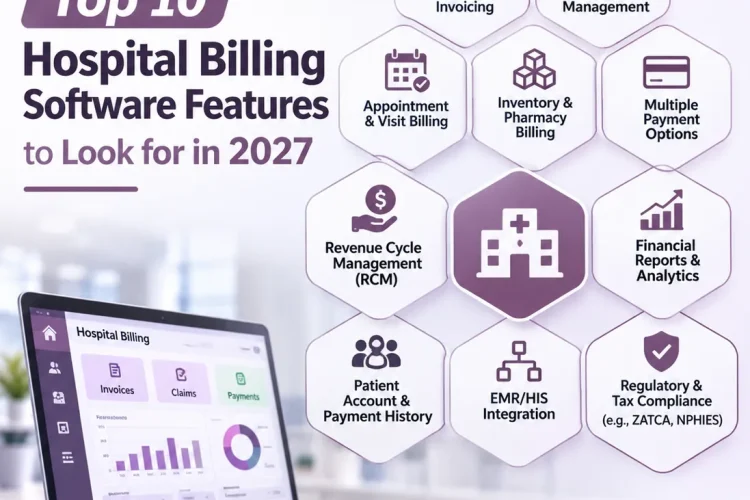
10 Essential Hospital Billing Software Features to Look for in 2027
Choosing the right hospital billing solution requires understanding the Medical Billing Software Features that support your hospital’s financial and operational requirements.
Here are ten essential features to consider.
1. Automated Patient Billing and Invoicing
Automated patient billing reduces manual calculations and simplifies invoice generation.
The system should support:
- Automatic invoice generation.
- Consultation and procedure charges.
- Service-wise billing.
- Discounts and promotional offers.
- Tax calculations.
- Digital and printable receipts.
- Invoice cancellation and refund workflows.
These capabilities help billing teams process transactions efficiently while maintaining accurate financial records.
2. OPD and IPD Billing Management
Hospitals need different billing workflows for outpatient and inpatient services.
OPD billing software should manage consultation fees, follow-up charges, diagnostic investigations, and outpatient procedures.
IPD billing software should support admission charges, room and bed charges, nursing services, medications, surgical procedures, deposits, interim bills, and final discharge settlements.
An integrated billing solution allows hospitals to manage both workflows without maintaining separate financial records.
3. Insurance Claims and Third-Party Payer Management
Insurance billing is an important component of hospital revenue cycle management.
Look for capabilities such as:
- Insurance company and payer management.
- Policy and coverage information.
- Pre-authorization tracking.
- Claim generation and submission.
- Claim status monitoring.
- Rejection and denial management.
- Insurance payment reconciliation.
For hospitals operating in Saudi Arabia, UAE, and other regulated healthcare markets, the system should also support the relevant country-specific payer and health information exchange requirements.
4. Patient Billing Software and Payment Tracking
Patient billing software helps hospitals maintain complete records of patient financial transactions.
Important capabilities include:
- Patient account management.
- Payment history.
- Partial and advance payments.
- Outstanding balance tracking.
- Refund management.
- Payment receipts.
- Multiple payment methods.
These features improve transparency and help hospital finance teams identify unpaid invoices and pending collections.
5. Pharmacy and Laboratory Billing Integration
Hospitals generate revenue through multiple departments, including pharmacies and diagnostic laboratories.
Hospital billing software should connect these departments with the central billing system.
For example:
- Pharmacy purchases can be added to patient invoices.
- Laboratory investigations can generate corresponding service charges.
- Diagnostic packages can be billed automatically.
- Department-wise collections can be monitored.
- Pharmacy returns and billing adjustments can be recorded.
Integration reduces duplicate data entry and provides better visibility into departmental revenue.
6. Healthcare Revenue Cycle Management Software
Revenue cycle management (RCM) covers the financial journey from patient registration and service delivery to billing, claims processing, payment collection, and account reconciliation.
An integrated healthcare revenue cycle management software solution should help hospitals manage:
- Patient registration and eligibility information.
- Charge capture.
- Medical coding and billing validation.
- Insurance claims.
- Payment posting.
- Denial management.
- Accounts receivable.
- Financial performance reporting.
The objective is to reduce billing errors, improve collections, and minimize revenue leakage.
7. Discount, Package and Tariff Management
Hospitals frequently offer different prices depending on departments, procedures, insurance agreements, and patient categories.
A suitable billing system should provide:
- Service-wise price lists.
- Department-specific tariffs.
- Insurance and corporate rates.
- Medical packages.
- Discount rules.
- Approval-based discounts.
- Complete discount and adjustment logs.
These features help maintain consistent pricing and improve financial control.
8. Financial Reports and Revenue Dashboards
Hospital administrators need accurate financial information to make informed decisions.
Look for dashboards that provide:
- Daily, weekly, and monthly revenue.
- Department-wise collections.
- OPD and IPD billing reports.
- Outstanding invoices.
- Insurance receivables.
- Refund and discount reports.
- Payment method breakdown.
- Cashier performance.
Real-time reporting helps management understand financial performance without depending entirely on manual spreadsheets.
9. Security, User Roles and Audit Trails
Hospital financial information contains sensitive patient and transaction data.
A reliable solution should include:
- Role-based access control.
- User-specific permissions.
- Secure patient and financial records.
- Invoice modification history.
- Discount approval logs.
- Payment transaction history.
- User activity tracking.
Audit trails help administrators understand who performed a financial transaction and when changes were made.
10. EMR, HIS and Accounting Integration
Billing should not operate as an isolated department.
Integration with electronic medical records (EMR), hospital information systems (HIS), laboratory information systems (LIS), pharmacy management, and accounting platforms allows information to move between departments.
For example, when a doctor orders a laboratory investigation, the service can flow into the patient’s billing account without requiring staff to enter the same information again.
This creates a more connected hospital financial workflow.
Benefits of Hospital Billing Software for Healthcare Providers
Implementing hospital billing software can improve financial operations and administrative efficiency.
| Benefit | How it helps |
|---|---|
| Faster billing | Automates invoice generation and calculations |
| Fewer billing errors | Reduces manual data entry |
| Improved collections | Tracks outstanding payments |
| Better insurance management | Organizes claims and payer information |
| Revenue visibility | Provides department-wise reports |
| Financial transparency | Maintains transaction histories |
| Better patient experience | Provides clear invoices and receipts |
| Operational efficiency | Connects billing with hospital departments |
The biggest advantage is improved coordination between clinical services and financial operations.
Hospital Billing Software vs Clinic Billing Software
Hospital and clinic billing software serve similar purposes, but their operational requirements are different.
| Feature | Hospital Billing Software | Clinic Billing Software |
|---|---|---|
| Patient registration | Advanced | Basic to advanced |
| OPD billing | Yes | Yes |
| IPD billing | Essential for inpatient facilities | Usually not required |
| Bed and room charges | Yes | Usually not required |
| Pharmacy integration | Department-wide | Optional |
| Laboratory billing | Integrated | Optional |
| Insurance claims | Advanced workflows | Depends on clinic |
| Department reporting | Multiple departments | Clinic-level |
| Multi-location management | Often required | Depends on organization |
| Revenue reporting | Hospital-wide | Practice-level |
Which one should you choose?
Hospitals with multiple departments, inpatient services, pharmacies, laboratories, and insurance operations generally require hospital billing software.
Independent doctors, outpatient practices, and small medical centers may find clinic billing software more suitable.
Medical Billing Software Price in Pakistan: What Should Hospitals Expect?
The price of medical billing software in Pakistan depends on the size of the healthcare organization, number of users, required modules, deployment model, customization, and integration requirements.
There is no single price that applies to every hospital or clinic.
Common pricing factors include:
- Number of users: More billing counters and staff accounts may increase licensing costs.
- Hospital size: Multi-specialty hospitals generally require more advanced workflows.
- Required modules: OPD, IPD, pharmacy, laboratory, and insurance billing can affect pricing.
- Deployment model: Cloud-based and on-premises solutions may have different cost structures.
- Customization: Specialized billing workflows and integrations can increase implementation costs.
- Support and maintenance: Training, technical support, upgrades, and ongoing maintenance should be considered.
Before purchasing, hospitals should request a customized quotation and evaluate the total cost of ownership rather than comparing subscription prices alone.
Medical Billing Software vs Hospital Management Software
Medical Billing Software focuses primarily on financial transactions, while hospital management software (HMS) manages broader hospital operations.
| Comparison | Medical Billing Software | Hospital Management Software |
|---|---|---|
| Main purpose | Financial management | Complete hospital operations |
| Patient invoicing | Yes | Usually included |
| Payment tracking | Yes | Usually included |
| Insurance claims | Billing-focused | Depends on modules |
| Appointment management | Limited or integrated | Yes |
| EMR management | Integration or limited functionality | Yes |
| Pharmacy management | Billing integration | Full pharmacy workflows may be included |
| Laboratory management | Billing integration | Full laboratory workflows may be included |
| Staff management | Limited | Usually included |
| Hospital-wide reporting | Financial reports | Clinical and financial reports |
Which is better?
If your primary requirement is managing invoices, payments, and financial transactions, medical billing software may be sufficient.
If you want to manage appointments, patient records, doctors, pharmacy, laboratory, admissions, and billing through one platform, an integrated hospital management system is a more comprehensive option.
Laboratory Billing Software: Why Integration Matters

sammerEdit Profile
Laboratories process multiple diagnostic services every day, making accurate billing and payment tracking essential.
Laboratory billing software helps diagnostic centers manage:
- Test-wise pricing.
- Diagnostic packages.
- Patient invoices.
- Corporate and insurance rates.
- Sample-related service charges.
- Payment tracking.
- Laboratory revenue reports.
When integrated with a Laboratory Information Management System (LIMS) or Laboratory Information System (LIS), billing information can connect with laboratory orders and diagnostic workflows.
This reduces manual processes and improves financial visibility across laboratory operations.
How to Choose the Best Hospital Billing Software in 2027
Selecting the right hospital billing software requires evaluating both current requirements and future operational needs.
Before making a decision, consider these factors:
1. Understand your hospital’s requirements
Identify whether you need OPD billing, IPD billing, insurance management, pharmacy billing, laboratory billing, or complete revenue cycle management.
2. Evaluate automation capabilities
Choose software that automates invoice generation, payment tracking, insurance workflows, and financial reporting.
3. Check integration capabilities
Ensure the solution can integrate with EMR, HIS, LIS, pharmacy, and accounting systems.
4. Consider scalability
Your software should support additional departments, users, branches, and healthcare facilities as your organization grows.
5. Evaluate security and compliance
Check access controls, audit trails, data protection, and applicable healthcare regulations in your operating country.
6. Request a live demonstration
Test actual billing scenarios, including patient registration, consultation charges, insurance claims, discounts, refunds, and final payments.
7. Compare total implementation costs
Evaluate licensing, customization, training, integrations, maintenance, and technical support before selecting a provider.
How Health Cluster Supports Hospital Billing Operations
Suggested brand section – commercial conversion content
Manage Healthcare Billing with Health Cluster
Hospitals need connected technology to manage financial activities across different departments. Health Cluster offers an integrated healthcare software ecosystem designed to support hospitals, clinics, and medical centers.
With Health Cluster, healthcare providers can connect billing activities with clinical and administrative workflows.
Key capabilities include:
- Patient Billing: Manage patient invoices, consultation fees, procedures, services, and payments.
- OPD and IPD Workflows: Support outpatient and inpatient financial operations.
- Insurance and RCM: Connect financial workflows with insurance and revenue cycle management processes.
- Pharmacy and Laboratory: Integrate departmental services with patient billing.
- Financial Reporting: Monitor collections, outstanding balances, discounts, and financial performance.
- E-Invoicing: Support electronic invoice generation and document management.
- Integrated EMR and HIS: Connect financial operations with patient records and hospital workflows.
Health Cluster also provides healthcare e-invoicing capabilities for managing patient, third-party payer, and company billing. Smart E-Invoicing Software+1
Whether you operate a multi-specialty hospital, medical center, diagnostic laboratory, or outpatient clinic, Health Cluster helps bring healthcare workflows into a connected digital environment.
Looking for hospital billing software that supports your healthcare operations?
Explore Medical Billing Software and discover how integrated healthcare technology can help streamline billing, improve financial visibility, and support operational efficiency.
Frequently Asked Questions About Hospital Billing Software
1. What is the best hospital billing software in 2027?
The best hospital billing software is one that supports OPD and IPD billing, insurance claims, patient payments, pharmacy and laboratory integration, financial reporting, and revenue cycle management. The right solution depends on hospital size and operational requirements.
2. How much does hospital billing software cost in Pakistan?
Hospital billing software prices in Pakistan vary depending on the number of users, hospital size, modules, customization, deployment, and support requirements. Hospitals should request a customized quotation based on their operational needs.
3. What are the essential features of hospital billing software?
Essential features include automated invoicing, OPD and IPD billing, insurance management, patient payment tracking, pharmacy and laboratory billing, discount management, financial reporting, audit trails, and EMR integration.
4. What is the difference between hospital billing software and clinic billing software?
Hospital billing software supports complex financial operations, including inpatient billing, insurance claims, pharmacy, laboratory, and multiple departments. Clinic billing software primarily focuses on consultations, patient invoices, payments, and outpatient services.
5. Can hospital billing software manage insurance claims?
Yes. Advanced hospital billing software can support insurance company management, eligibility information, pre-authorizations, claim generation, submission tracking, rejection management, and payment reconciliation.
6. Does hospital billing software integrate with EMR systems?
Yes. Integrated billing solutions connect patient records, clinical services, diagnoses, procedures, and medical orders with financial transactions to reduce duplicate data entry.
7. What is the difference between medical billing software and RCM software?
Medical billing software primarily manages invoices, payments, and billing transactions. Revenue cycle management software covers a broader financial process, including registration, eligibility, charge capture, claims, payment posting, denial management, and accounts receivable.
8. Is hospital billing software suitable for small hospitals?
Yes. Small hospitals can use billing solutions that support essential functions such as patient invoicing, consultation charges, payment tracking, and financial reporting. They can expand to additional modules as their requirements grow.
9. Can laboratory billing software be integrated with hospital billing?
Yes. Integration allows laboratory services, diagnostic packages, and investigation charges to flow into the patient’s financial account, helping hospitals manage departmental billing centrally.
10. Why should hospitals choose integrated medical billing software?
Integrated medical billing software connects financial transactions with clinical and administrative operations. This improves information flow, reduces repetitive work, and provides better visibility into hospital revenue.
Conclusion: Choose the Right Hospital Billing Software for 2027
Hospital billing software plays an important role in improving financial management, reducing manual billing processes, and maintaining accurate patient payment records.
From OPD and IPD billing to insurance claims, pharmacy transactions, laboratory charges, and revenue cycle management, the right solution can help healthcare organizations manage their financial operations more efficiently.
When evaluating hospital billing software in 2027, prioritize automation, integration, scalability, security, and financial reporting.
Health Cluster provides an integrated healthcare technology platform that connects billing with broader hospital and clinical workflows, helping healthcare providers move toward more efficient digital operations.
Explore Health Cluster’s Medical Billing Software to discover a connected solution for your hospital’s billing and financial management requirements.
