
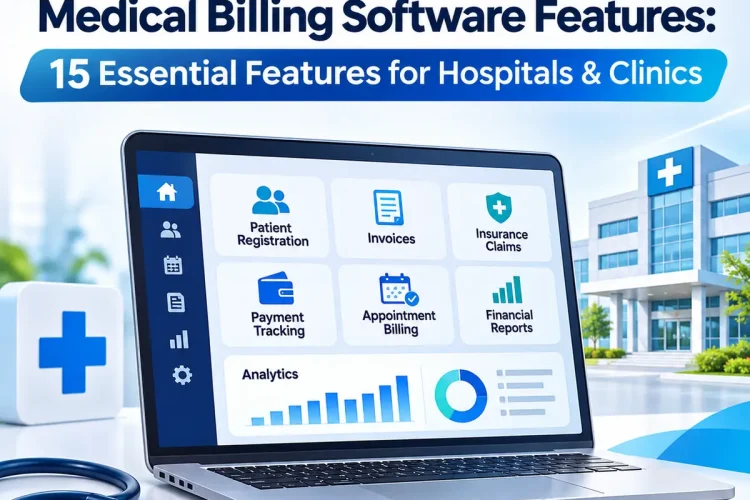
Medical billing is an essential part of healthcare operations. Hospitals, clinics, diagnostic laboratories and medical centres need an organized way to manage patient charges, invoices, payments, insurance claims and financial records.
Medical billing software features help healthcare providers automate financial workflows, improve billing accuracy, track outstanding payments and gain better visibility into revenue performance. Instead of relying on spreadsheets and manual calculations, healthcare organizations can manage billing activities through a centralized digital system.
In Pakistan, healthcare providers increasingly need billing solutions that can support different departments, patient payment workflows, local currency requirements and integration with broader hospital management systems.
In this guide, we explore 15 essential medical billing software features, their benefits and what hospitals and clinics should consider before selecting a solution.
What Is Medical Billing Software?
Medical billing software is a digital solution that helps healthcare providers manage patient charges, generate invoices, record payments, track outstanding balances and monitor financial transactions.
It connects billing activities with healthcare workflows such as patient registration, appointments, doctor consultations, laboratory services, pharmacy transactions and hospital admissions.
Depending on the system, medical billing software can also support insurance claims, revenue cycle management, financial reporting and integrations with Electronic Medical Records (EMR) and Hospital Information Systems (HIS).
15 Essential Medical Billing Software Features
Choosing the right medical billing system requires evaluating more than invoice generation. A comprehensive solution should support the complete billing process, from patient registration to payment reconciliation and financial reporting.
1. Patient Registration and Billing Management
Patient registration is the starting point of an organized billing process. The software should maintain patient information and connect billing transactions with individual patient records.
Essential capabilities include:
- Patient registration and unique patient identification.
- Patient billing history and previous invoices.
- Consultation and service charge management.
- Patient account and outstanding balance tracking.
- Access to previous transactions and receipts.
This feature helps reception and billing teams maintain accurate patient financial records.
2. Automated Invoice Generation
Automated invoicing reduces manual calculations and helps standardize billing operations.
Look for capabilities such as:
- Automatic invoice generation.
- Itemized billing for consultations and procedures.
- Customizable invoice templates.
- Digital and printable receipts.
- Invoice cancellation and adjustment controls.
- Unique invoice numbers and transaction references.
Hospitals and clinics can use automated invoicing to improve billing consistency and reduce administrative workload.
3. OPD and IPD Billing Management
Hospitals need billing software that supports both outpatient and inpatient workflows.
OPD billing features:
- Consultation fee management.
- Doctor and specialist charges.
- Procedure and service billing.
- Follow-up visit charges.
- Patient payment receipts.
IPD billing features:
- Admission-related charges.
- Room and bed charges.
- Nursing and treatment charges.
- Laboratory and radiology charges.
- Pharmacy and medication charges.
- Discharge billing and final invoice preparation.
Hospital billing software should connect departmental charges with the patient’s overall financial account.
4. Clinic Billing Management
Clinic billing software should simplify daily financial operations for individual doctors, specialist practices and multi-specialty clinics.
Important features include:
- Consultation fee configuration.
- Doctor-wise billing.
- Appointment-linked invoices.
- Procedure and treatment charges.
- Patient payment tracking.
- Daily collection reports.
These capabilities help small clinics manage billing without maintaining complicated manual registers.
5. Laboratory Billing Management
Diagnostic laboratories process multiple tests and service requests, making accurate billing important.
A laboratory billing software solution should support:
- Laboratory test price configuration.
- Individual and panel-based test billing.
- Patient-linked laboratory invoices.
- Package and profile billing.
- Discounts and payment tracking.
- Integration with Laboratory Information Systems (LIS).
Connecting laboratory billing with diagnostic workflows helps reduce duplicate data entry and improves financial visibility.
6. Insurance Billing and Claims Management
Healthcare organizations working with insurance providers need structured insurance billing workflows.
Depending on the market and payer integrations, useful capabilities include:
- Insurance company and payer management.
- Policy and coverage information.
- Patient eligibility verification.
- Preauthorization tracking.
- Claim generation and submission.
- Claim status monitoring.
- Rejection and denial tracking.
- Payment reconciliation.
For healthcare providers in Saudi Arabia, integration with NPHIES may also be an important requirement when selecting healthcare billing and RCM software.
7. Payment Management and Outstanding Balances
A good patient billing software solution should provide visibility into collected payments and unpaid balances.
Essential capabilities include:
- Cash and bank payment recording.
- Card and digital payment recording.
- Partial payment management.
- Advance payment tracking.
- Refund management.
- Outstanding balance monitoring.
- Patient payment history.
This helps finance teams monitor collections and follow up on pending payments.
8. Discounts, Packages and Tax Management
Healthcare providers frequently offer treatment packages, service discounts and special pricing arrangements.
The billing system should support:
- Fixed and percentage-based discounts.
- Service-specific pricing.
- Treatment and consultation packages.
- Promotional pricing.
- Configurable tax rules.
- Tax breakdown on invoices.
- Authorized discount approvals.
For Pakistani healthcare organizations, evaluate the applicable FBR and provincial tax requirements according to the organization’s services and legal obligations.
9. Pharmacy and Service Billing Integration
Healthcare billing becomes more efficient when pharmacy and clinical service transactions are connected.
Important capabilities include:
- Medicine and pharmacy item billing.
- Consultation and procedure charges.
- Service catalogue management.
- Pharmacy sales and returns.
- Inventory-linked transactions.
- Department-wise financial tracking.
Integration helps hospitals maintain a connected financial record across different departments.
10. Financial Reports and Dashboards
Medical billing software should provide administrators with meaningful financial information.
Useful reports include:
- Daily, weekly and monthly collection reports.
- Patient-wise billing reports.
- Doctor-wise revenue reports.
- Department-wise revenue reports.
- Outstanding payment reports.
- Discount and refund reports.
- Payment method summaries.
- Revenue and collection dashboards.
These reports help management identify financial trends and make informed operational decisions.
11. Role-Based Access and Audit Trails
Healthcare financial information should be accessible only to authorized users.
Look for:
- Role-based permissions.
- Separate access for reception and finance teams.
- Authorized invoice adjustments.
- Transaction history.
- User activity logs.
- Audit trails for financial changes.
These controls improve accountability and help organizations monitor billing activities.
12. Multi-Branch Billing Management
Healthcare groups operating multiple clinics or hospitals need centralized financial visibility.
Useful features include:
- Branch-wise billing configuration.
- Separate service pricing.
- Branch-level collection reports.
- Centralized financial dashboards.
- User and department permissions.
- Consolidated management reporting.
This functionality becomes particularly important as healthcare organizations expand across different cities in Pakistan.
13. EMR and Hospital Management System Integration
Billing should not operate as an isolated function.
Integration with EMR and HIS allows billing information to connect with patient registration, appointments, consultations, prescriptions, laboratory orders and hospital services.
Important integration capabilities include:
- Patient demographic synchronization.
- Appointment-linked billing.
- Clinical service charge integration.
- Pharmacy and laboratory integration.
- Financial data exchange.
- Accounting system integration.
- API-based connectivity.
This creates a more connected healthcare administration environment.
14. Healthcare Revenue Cycle Management (RCM)
Revenue Cycle Management software helps healthcare organizations manage financial activities throughout the patient journey.
Important RCM capabilities include:
- Charge capture.
- Insurance verification.
- Claims management.
- Payment posting.
- Denial management.
- Accounts receivable monitoring.
- Revenue reporting.
- Financial reconciliation.
An integrated healthcare revenue cycle management software solution can help organizations identify revenue gaps and improve financial process visibility.
15. Cloud-Based Access and Data Security
Modern medical billing software should provide secure and reliable access to authorized users.
Evaluate the following capabilities:
- Secure user authentication.
- Role-based access controls.
- Data encryption.
- Regular database backups.
- Audit logging.
- Controlled remote access.
- System availability and disaster recovery planning.
Healthcare organizations should evaluate the vendor’s actual security controls, hosting arrangements and applicable regulatory requirements before implementation.
Benefits of Medical Billing Software for Healthcare Providers
Implementing the right billing solution can improve financial and administrative operations.
Key benefits include:
- Improved billing accuracy: Standardized workflows help reduce manual calculation errors.
- Faster invoice processing: Automated invoicing reduces repetitive administrative tasks.
- Better payment visibility: Finance teams can monitor paid and outstanding amounts.
- Improved revenue tracking: Department-wise reports provide clearer financial insights.
- Reduced manual workload: Connected workflows reduce duplicate data entry.
- Better financial accountability: Permissions and audit trails help track transactions.
- Scalable operations: Multi-branch functionality supports organizational growth.
Medical Billing Software vs Hospital Management Software
Medical billing software and hospital management software serve related but different purposes.
| Comparison | Medical Billing Software | Hospital Management Software |
|---|---|---|
| Main purpose | Financial and billing operations | Overall hospital administration |
| Patient billing | Core functionality | Integrated module |
| OPD management | Billing-focused | Complete OPD workflow |
| IPD management | Inpatient charges | Admission and clinical workflows |
| Laboratory | Laboratory billing | LIS and diagnostic workflows |
| Pharmacy | Pharmacy billing | Pharmacy and inventory |
| EMR | May integrate | Usually broader clinical functionality |
| Financial reporting | Billing and collection reports | Organization-wide reporting |
For organizations that want both financial management and clinical administration, an integrated HIS or hospital management system with comprehensive billing functionality may be more suitable.
Medical Billing Software Price in Pakistan
The price of medical billing software in Pakistan depends on the organization’s size, number of users, required modules, deployment model and integration requirements.
Common pricing considerations include:
- Number of doctors and users.
- Number of branches and departments.
- OPD and IPD billing requirements.
- Laboratory and pharmacy integration.
- Insurance and claims management.
- Custom reporting requirements.
- Implementation, training and support.
- Hosting and maintenance costs.
Small clinics may require a basic billing solution, while hospitals and healthcare networks generally need a more comprehensive platform.
How to Choose Medical Billing Software for Your Healthcare Organization
Before selecting a solution, evaluate your current billing process and future operational requirements.
Consider these important questions:
- Does the software support your clinic, hospital or laboratory billing workflows?
- Can it manage OPD and IPD charges?
- Does it support partial payments, refunds and outstanding balances?
- Can it integrate with EMR, HIS, LIS and pharmacy systems?
- Does it provide detailed financial reports?
- Can you configure service prices, discounts and taxes?
- Does it provide role-based permissions and audit trails?
- Can the solution support multiple branches?
- What are the implementation and maintenance costs?
- Does the vendor provide training, technical support and a product demonstration?
Request a demonstration using your actual healthcare workflows before making a final decision.
Manage Healthcare Billing with Health Cluster
Health Cluster provides healthcare technology solutions designed to connect clinical and administrative workflows across healthcare organizations.
For hospitals, clinics and diagnostic centres, an integrated healthcare platform can help connect patient administration, medical records, departmental services and financial operations.
With connected healthcare workflows, organizations can work toward better billing visibility, streamlined administration and more organized financial management.
Whether you operate a small clinic, a multi-specialty medical centre or a hospital, evaluate your billing requirements and choose a solution that can support your current operations and future growth.
Looking for medical billing software for your healthcare organization?
Explore Medical Billing Software or request a product demonstration to understand how healthcare billing workflows can fit your organization’s requirements.
Frequently Asked Questions
1. What are the most important medical billing software features?
The most important features include patient registration, automated invoicing, OPD and IPD billing, payment tracking, insurance claims management, financial reporting, tax configuration, role-based access and EMR integration.
2. What features should hospital billing software include?
Hospital billing software should support outpatient and inpatient billing, admission charges, doctor fees, laboratory and pharmacy billing, insurance claims, patient payments, refunds and department-wise financial reports.
3. Is medical billing software suitable for small clinics?
Yes. Medical billing software for small clinics can help manage consultation fees, patient invoices, payment records, outstanding balances and daily collection reports without requiring complex hospital-wide workflows.
4. Can medical billing software manage laboratory billing?
Yes. Depending on the solution, laboratory billing can include individual test charges, test packages, patient invoices, discounts, payment tracking and integration with laboratory information systems.
5. What is the difference between medical billing software and RCM software?
Medical billing software primarily manages patient charges, invoices and payments. Revenue Cycle Management (RCM) software covers a broader financial workflow, including insurance verification, claims, payment posting, denial management and accounts receivable.
6. How much does medical billing software cost in Pakistan?
Pricing varies depending on users, modules, branches, integrations, hosting and customization. Healthcare providers should request a quotation based on their actual operational requirements.
7. Can medical billing software integrate with EMR and HIS?
Yes. Many modern solutions support integration with EMR and HIS platforms, allowing patient information, clinical services and billing transactions to work together.
8. How do I choose the right medical billing software?
Evaluate billing workflows, payment management, reporting, insurance requirements, security, integration capabilities, scalability, implementation costs and technical support before selecting a vendor.
