
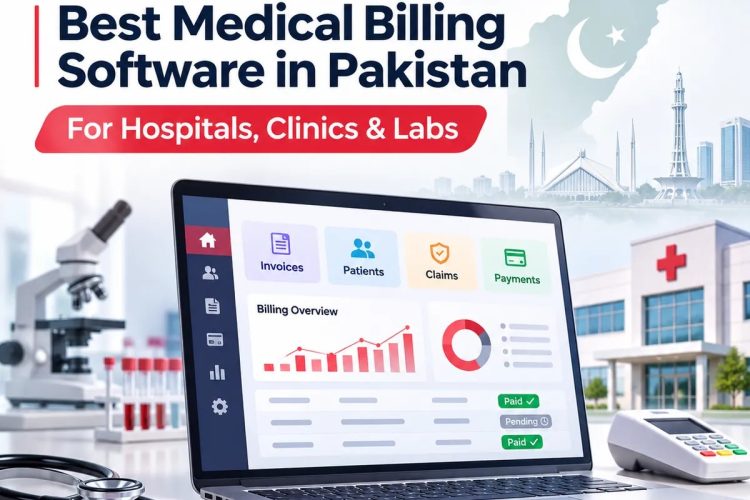
Managing medical billing, patient payments, invoices, and insurance claims can become complicated as healthcare facilities grow. Hospitals, clinics, and diagnostic laboratories need a reliable system to manage billing operations, reduce administrative workload, and maintain accurate financial records.
Medical billing software helps healthcare providers automate billing workflows, generate invoices, track payments, manage outstanding balances, and improve financial visibility through a centralized platform.
Health Cluster provides an integrated healthcare management solution designed to support medical billing and revenue management workflows for healthcare organizations in Pakistan. Whether you operate a hospital, private clinic, or diagnostic laboratory, the right billing system can help streamline daily financial operations and improve the patient billing experience.
If you are looking for the best medical billing software in Pakistan, it is important to evaluate its features, billing capabilities, pricing, scalability, and integration options before making a decision.
What Is Medical Billing Software?
Medical billing software is a digital solution that helps healthcare organizations manage patient charges, invoices, payments, insurance-related billing, and financial records.
It connects billing activities with clinical and administrative workflows to help ensure that services provided to patients are accurately reflected in their bills.
For example, when a doctor provides a consultation, prescribes a diagnostic test, or recommends a medical procedure, the corresponding service charges can be recorded and processed through the billing system.
A medical billing system typically supports:
- Patient registration and billing records
- Consultation and procedure charges
- Invoice generation and management
- Payment collection and tracking
- Insurance billing and claims workflows
- Discounts and payment adjustments
- Outstanding balance management
- Financial reports and revenue tracking
For Pakistani healthcare providers, a centralized billing solution can help improve operational efficiency and provide better control over financial activities.
Medical Billing Software Features: What Should You Look For?
Choosing medical billing software requires more than checking whether it can generate invoices. Healthcare providers should evaluate features that support the complete billing lifecycle.
Here are some essential medical billing software features to consider.
1. Patient Registration and Billing Management
The system should connect patient records with billing activities. This allows receptionists and billing teams to access patient information, create invoices, and review previous transactions without maintaining separate records.
2. Automated Invoice Generation
A good medical billing solution should generate invoices based on consultations, procedures, laboratory tests, and other healthcare services.
Automated invoice generation reduces repetitive data entry and helps maintain consistent billing records.
3. Payment Tracking and Management
Healthcare facilities need visibility into collected payments, pending balances, partial payments, and outstanding invoices.
The software should support multiple payment methods and maintain a clear transaction history.
4. Insurance Billing and Claims Management
Healthcare providers working with insurance companies need organized billing and claims workflows.
Look for features that support insurance information, payer details, claim preparation, claim status tracking, and reconciliation where applicable.
5. Discount and Package Management
Medical billing software should support configurable discounts, service packages, and applicable pricing rules.
This helps healthcare organizations manage different billing arrangements while maintaining accurate financial records.
6. Financial Reports and Revenue Tracking
Reporting capabilities help administrators understand billing performance.
Important reports include:
- Daily and monthly billing summaries
- Payment collection reports
- Outstanding invoice reports
- Service-wise revenue reports
- Doctor-wise revenue reports
- Discount and adjustment reports
7. Integration with Hospital Management Systems
Billing should not operate independently from clinical operations.
Integration with appointment management, EMR, pharmacy, laboratory, and other hospital modules can reduce duplicate data entry and improve coordination between departments.
Hospital Billing Software for Healthcare Facilities
Hospitals manage multiple departments, medical billing services, and patient billing workflows. Their billing requirements are generally more complex than those of smaller healthcare facilities.
Hospital billing software should support interconnected workflows across outpatient departments (OPD), inpatient departments (IPD), emergency services, pharmacy, laboratories, radiology, and other clinical units.
Essential hospital billing capabilities include:
- OPD and IPD billing
- Consultation and procedure billing
- Department-wise service charges
- Admission-related billing workflows
- Pharmacy and laboratory billing
- Insurance and corporate billing
- Payment collection and reconciliation
- Financial reporting and analytics
An integrated hospital billing system helps reduce manual coordination between departments and provides administrators with better financial visibility.
Clinic Billing Software for Private Practices
Private clinics need a straightforward billing solution that supports everyday patient transactions without unnecessary administrative complexity.
Clinic billing software should make it easy for receptionists and clinic administrators to create invoices, collect payments, and manage patient billing records.
Useful clinic billing features include:
- Patient registration
- Appointment-based billing
- Doctor consultation charges
- Treatment and procedure billing
- Invoice and receipt generation
- Partial and full payment tracking
- Discount management
- Daily collection reports
For clinics with multiple practitioners or branches, a centralized system can also help maintain consistent billing records and operational visibility.
Medical Billing Software Price in Pakistan: What Does It Cost?
The medical billing software price in Pakistan depends on the size of the healthcare organization, required modules, number of users, implementation requirements, and integration complexity.
There is no single price that applies to every hospital or clinic. A small private practice may need basic patient billing, while a multi-specialty hospital may require advanced financial management, insurance workflows, and integrations with other healthcare departments.
Factors that influence medical billing software pricing include:
| Pricing factor | What it includes |
|---|---|
| Healthcare facility size | Clinic, diagnostic lab, or hospital |
| Number of users | Doctors, receptionists, and billing staff |
| Software modules | Billing, EMR, pharmacy, LIS, and RCM |
| Deployment model | Cloud-based or on-premises |
| Customization | Organization-specific billing workflows |
| Integration | Accounting, payment, and insurance systems |
| Implementation | Setup, training, and onboarding |
Before purchasing a solution, request a detailed quotation that explains licensing, implementation, support, integrations, and recurring costs.
Looking for medical billing software pricing in Pakistan? Contact Health Cluster to discuss your requirements and request a customized quotation.
Patient Billing Software: Improving the Patient Payment Experience
Patient billing management software helps healthcare providers maintain accurate patient charges, invoices, payment histories, and outstanding balances.
A structured patient billing process helps patients understand the services they have been charged for and enables administrative teams to track financial transactions more efficiently.
Important patient billing capabilities include:
- Patient-wise billing history
- Itemized invoices
- Consultation and treatment charges
- Payment receipts
- Partial payment management
- Outstanding balance tracking
- Discounts and adjustments
- Billing summaries
By connecting patient billing with registration and clinical workflows, healthcare providers can reduce duplicate records and improve the overall billing experience.
Healthcare Revenue Cycle Management Software
Medical billing is one part of the broader financial process known as revenue cycle management (RCM).
Healthcare revenue cycle management software helps healthcare organizations manage financial activities throughout the patient journey, from registration and eligibility verification to charge capture, claims processing, payment posting, and account reconciliation.
A well-organized RCM workflow typically includes:
- Patient registration and demographic verification.
- Insurance information and eligibility checks, where applicable.
- Service documentation and charge capture.
- Invoice generation and claim preparation.
- Claim submission and status monitoring.
- Payment posting and reconciliation.
- Denial management and follow-up.
- Outstanding account management.
For hospitals and clinics working with insurance providers, an integrated RCM solution can improve financial visibility and help identify delays in the payment cycle.
Medical billing software primarily handles billing transactions, while RCM software covers the wider financial lifecycle.
Laboratory Billing Software for Diagnostic Centres
Diagnostic laboratories process different types of tests, investigations, and diagnostic services. Managing their billing manually can create additional administrative work.
Laboratory billing software should connect test orders, service pricing, patient information, invoices, and payment records.
Important capabilities include:
- Test-wise billing
- Patient registration and billing
- Laboratory service pricing
- Package and profile billing
- Invoice generation
- Payment tracking
- Discount management
- Daily collection reports
When laboratory billing is integrated with a Laboratory Information Management System (LIMS), healthcare providers can coordinate diagnostic workflows and financial transactions more efficiently.
Medical Billing Software for Small Clinics
Small clinics often operate with limited administrative resources. They need medical billing software that is easy to use, affordable, and capable of supporting everyday operations.
The ideal solution should provide essential billing functionality without requiring complex implementation.
Small clinics should prioritize:
- Simple patient registration
- Consultation billing
- Digital invoices and receipts
- Payment tracking
- Doctor-wise billing reports
- Service and procedure pricing
- User access management
- Room for future expansion
A scalable solution allows clinics to start with essential billing workflows and expand into additional healthcare management modules as their requirements grow.
Medical Billing vs Hospital Management Software: What Is the Difference?
Medical billing software and hospital management software serve related but different purposes.
Medical billing software focuses primarily on financial transactions, while hospital management software manages broader administrative, clinical, and operational activities.
| Feature | Medical Billing Software | Hospital Management Software |
|---|---|---|
| Patient registration | Billing-related records | Centralized patient registration |
| Invoice generation | Core functionality | Integrated functionality |
| Payment tracking | Core functionality | Integrated functionality |
| Appointment management | May be limited | Typically included |
| EMR management | Usually limited | Included in integrated solutions |
| Pharmacy management | May be integrated | Available as a module |
| Laboratory management | May be integrated | Available as a module |
| Hospital operations | Limited | Broader operational coverage |
| Financial reporting | Billing-focused | Organization-wide reporting |
For a small clinic with straightforward financial requirements, dedicated medical billing software may be sufficient.
For hospitals and growing healthcare networks, an integrated hospital management system with medical billing and revenue cycle management capabilities may provide greater operational value.
How to Choose Medical Billing Software in Pakistan
Selecting the right medical billing solution requires evaluating your current workflows and future business requirements.
Consider these factors before making a decision:
1. Understand Your Billing Requirements
Identify whether you need OPD billing, IPD billing, insurance billing, laboratory billing, or patient payment management.
2. Evaluate Essential Features
Check whether the software supports invoicing, payment tracking, discounts, service pricing, financial reporting, and relevant insurance workflows.
3. Check Integration Capabilities
The solution should integrate with your existing EMR, HIS, accounting software, pharmacy, or laboratory systems where required.
4. Review Data Security and Access Controls
Healthcare organizations manage sensitive patient and financial information. Evaluate user permissions, audit trails, data protection, backup policies, and deployment security.
5. Compare Pricing and Total Cost
Evaluate implementation charges, subscriptions, customization, training, maintenance, and support rather than comparing only the initial software price.
6. Request a Live Demonstration
A product demonstration allows your team to assess real billing scenarios, review system usability, and understand how the software fits your operational requirements.
7. Evaluate Local Support and Scalability
Choose a provider that understands your healthcare workflows, offers reliable implementation support, and can accommodate your organization’s future growth.
Why Choose Health Cluster for Medical Billing Software?
Health Cluster provides an integrated healthcare management platform designed to connect clinical, administrative, and financial operations.
Instead of managing billing activities through disconnected applications, healthcare providers can use an integrated environment to coordinate patient information, clinical services, and financial workflows.
Health Cluster supports healthcare organizations looking for capabilities across:
- Patient registration and management
- OPD and IPD workflows
- EMR and clinical documentation
- Appointment and practitioner management
- Medical billing and invoicing
- Pharmacy and inventory management
- Laboratory information management
- Revenue cycle management workflows
- Reporting and operational analytics
Whether you manage a private clinic, diagnostic centre, or multi-specialty hospital, Health Cluster can help you evaluate an appropriate solution based on your operational requirements.
The right medical billing solution should do more than generate invoices. It should help your healthcare organization establish connected, transparent, and manageable financial workflows.
Frequently Asked Questions About Medical Billing Software
What is the best medical billing software in Pakistan?
The best medical billing software in Pakistan depends on your organization’s size, billing requirements, integration needs, budget, and support expectations. Hospitals may require integrated OPD, IPD, insurance, and RCM capabilities, while smaller clinics may need basic patient invoicing and payment tracking.
How much does medical billing software cost in Pakistan?
Medical billing software pricing in Pakistan varies depending on the number of users, modules, deployment model, customization, and implementation requirements. Request a customized quotation to understand the total cost.
Which features should medical billing software include?
Essential features include patient registration, invoice generation, payment tracking, service pricing, discount management, insurance billing workflows, outstanding balance management, and financial reporting.
Is medical billing software suitable for small clinics?
Yes. Medical billing software can help small clinics manage consultation charges, patient invoices, payment records, receipts, and daily collections. The ideal solution should be simple, scalable, and aligned with the clinic’s budget.
What is the difference between medical billing software and RCM software?
Medical billing software focuses on invoices, patient charges, and payment collection. Revenue cycle management software covers the broader financial lifecycle, including registration, eligibility, charge capture, claims, payment posting, denials, and account follow-up.
Can medical billing software integrate with hospital management systems?
Yes. Depending on the solution, medical billing software can integrate with EMR, HIS, pharmacy, laboratory, appointment management, and accounting systems to support connected healthcare workflows.
What should hospitals consider before purchasing medical billing software?
Hospitals should evaluate OPD and IPD billing, insurance workflows, department-wise charges, payment management, reporting, integrations, data security, implementation support, and scalability.
Is cloud-based medical billing software better than on-premises software?
Both deployment models have advantages. Cloud-based systems can offer easier remote access and centralized maintenance, while on-premises systems provide greater control over local infrastructure. The appropriate choice depends on security requirements, IT resources, connectivity, and organizational policies.
Book a Medical Billing Software Demo with Health Cluster
Looking for reliable medical billing software in Pakistan for your hospital, clinic, or diagnostic centre?
Explore how Health Cluster can support your patient billing, invoicing, payment management, and healthcare financial workflows.
Our team can walk you through the relevant modules, understand your operational requirements, and help identify a suitable solution for your organization.
Ready to streamline your healthcare billing operations?
- Book a personalized product demo.
- Request medical billing software pricing.
- Discuss your hospital or clinic requirements.
Contact Health Cluster today to get started.
