
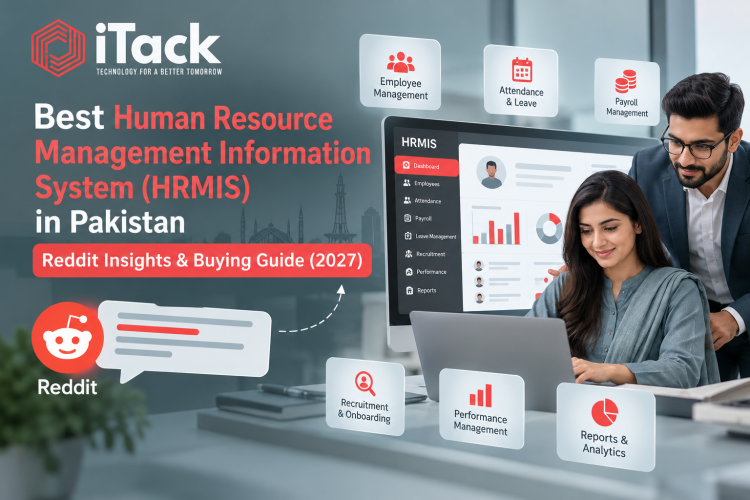
Choosing the right Human Resource Management Information System (HRMIS) can help Pakistani businesses simplify payroll, employee attendance, leave management, recruitment, and workforce administration. Whether you run a small business, manufacturing company, hospital, educational institution, or growing enterprise, the right HR software should fit your existing processes rather than create additional work.
If you are researching HRMIS software for the first time or considering replacing a system that no longer meets your needs, this guide explains the essential features, common implementation challenges, and questions to ask vendors before making a decision. It also examines publicly available Reddit discussions about HR and payroll software to identify practical considerations that buyers should evaluate.
What Is a Human Resource Management Information System (HRMIS)?
A Human Resource Management Information System (HRMIS) is software that helps organizations manage employee information and routine HR operations through a centralized platform. Depending on its capabilities, it can combine employee records, payroll, attendance, leave requests, recruitment, performance management, and HR reporting.
Instead of maintaining separate spreadsheets for employee details, attendance registers, salary calculations, and leave balances, companies can use an integrated system to manage these activities more efficiently.
For Pakistani businesses, an HRMIS may be particularly useful when managing multiple branches, different employee categories, shift-based workers, overtime, salary deductions, and monthly payroll processing.
Key Functions of HRMIS Software
A suitable HRMIS solution may include:
- Employee information management: Maintain employee profiles, employment contracts, designations, departments, and reporting structures.
- Payroll management: Calculate salaries, allowances, overtime, deductions, advances, and other configured payroll components.
- Attendance and shift management: Record working hours, late arrivals, absences, overtime, and shift schedules.
- Leave management: Configure leave policies, track balances, and automate approval workflows.
- Recruitment and onboarding: Manage job applications, candidate information, hiring steps, and employee onboarding.
- Performance management: Track goals, appraisals, reviews, and employee development.
- Employee self-service: Allow employees to access permitted information, request leave, and download available documents.
- HR reports and analytics: Generate reports covering headcount, attendance, payroll, turnover, and other workforce indicators.
Not every business needs every module. The right solution depends on the organization’s size, workforce structure, budget, and operational requirements.
Why Pakistani Businesses Are Searching for HRMIS Software
As organizations expand, manual HR administration can become increasingly difficult. A process that works for 15 employees may become unreliable when a company manages hundreds of employees across several locations.
Businesses in Pakistan may face several practical challenges when managing their workforce.
1. Manual Payroll Calculations and Errors
Calculating salaries manually can involve basic pay, allowances, overtime, unpaid leave, advances, deductions, and employee-specific adjustments. When information is collected from multiple spreadsheets or attendance devices, discrepancies can occur.
An HRMIS can bring the relevant information into a more structured workflow. However, businesses should verify the payroll rules, calculation logic, rounding, approval controls, and reporting outputs before relying on automated calculations.
2. Attendance and Overtime Management
Factories, hospitals, call centres, retail businesses, and other shift-based organizations may need to manage rotating shifts, night duties, overtime, weekly rest days, and attendance-device integrations.
A system should support the organization’s actual scheduling rules rather than forcing HR staff to correct attendance records manually after every payroll cycle.
3. Employee Data Spread Across Multiple Systems
Some businesses maintain employee information in spreadsheets, attendance software, accounting applications, and separate payroll tools. This can result in duplicate records, inconsistent employee details, and repeated data entry.
An integrated HRMIS can reduce these problems when the required modules genuinely share data and their integrations work reliably.
4. Limited Visibility Into HR Operations
Management may need accurate information about headcount, absences, employee turnover, overtime expenses, and department-wise workforce costs.
A reporting dashboard can help HR managers and business owners make decisions using consistent data instead of manually preparing every report.
What Reddit Discussions Reveal About HRMIS and Payroll Software
Public discussions on Reddit can provide useful examples of the practical issues businesses encounter when evaluating HR and payroll software. They should be treated as individual experiences, not as a statistically representative survey of Pakistani organizations.
In a November 2022 discussion in r/pakistan titled SME Payroll softwares are crap, a user described difficulties with payroll products, including limited customization, high per-employee costs, overtime-calculation problems, shift limitations, unnecessary fields, and unreliable attendance-data transfers in areas with poor internet connectivity.
The discussion highlights several questions Pakistani businesses should ask before purchasing an HRMIS:
- Can payroll calculations be configured to match our approved policies?
- Can unnecessary fields and workflows be adjusted?
- Does the system support our shifts, overtime rules, and employee categories?
- Can attendance data be transferred reliably from our existing devices?
- What happens when internet connectivity is limited?
- Will the total cost remain affordable as the workforce grows?
These are useful evaluation criteria, but a single discussion does not prove that every product mentioned has the same limitations today.
A separate Reddit discussion about HRMS recommendations from February 2026 focuses on requirements such as core employee records, payroll localization, leave and attendance, reporting, performance reviews, training, and employee self-service. Its context is the UAE, not Pakistan, so it should be used as a broader example of buyer requirements rather than evidence of Pakistani market preferences.
The practical lesson is straightforward: compare software against your actual business requirements, and verify vendor claims through demonstrations, reference checks, and realistic testing.
Essential Features to Look for in HRMIS Software in Pakistan
Before comparing vendors, prepare a checklist of the functions your organization needs today and the capabilities it may require as it grows.
1. Payroll Software With Configurable Rules
Payroll is often one of the most important HRMIS components. The system should handle your salary structure and approved payroll policies accurately.
Evaluate whether it supports:
- Basic salary and configurable allowances.
- Overtime and shift-related calculations.
- Attendance-based deductions and unpaid leave.
- Salary advances and employee loans, if applicable.
- Bonuses, commissions, and other variable payments.
- Payroll review, approval, and audit history.
- Salary slips and payroll reports.
- Relevant statutory deductions and reporting requirements.
For Pakistan, confirm how the vendor handles applicable income-tax rules, social security contributions, provincial requirements, and other relevant obligations. Ask how regulatory updates are implemented and who is responsible for maintaining the configuration.
Do not assume that a product supports every local requirement simply because its marketing describes it as payroll software.
2. Biometric and Mobile Attendance Integration
If your organization already uses biometric machines, RFID devices, mobile attendance, or access-control systems, confirm compatibility before purchasing.
Ask the vendor to demonstrate:
- Data synchronization with your specific device model.
- Handling of duplicate, missing, or incorrect punches.
- Shift assignment and overnight shifts.
- Overtime approval and exception management.
- Manual corrections with appropriate authorization and audit trails.
- Offline attendance collection and later synchronization, where supported.
This is particularly important for manufacturing facilities, hospitals, warehouses, and organizations with employees working across multiple locations.
3. Leave and Employee Self-Service
An effective leave-management module should allow organizations to configure leave categories, eligibility, accrual rules, approval hierarchies, and balance calculations.
Employee self-service can also reduce routine HR queries by allowing authorized users to review leave balances, submit requests, and access available documents.
During a demonstration, test how the system handles different employee groups, probation periods, department-specific approvals, and changes to leave policies.
4. Recruitment and Employee Lifecycle Management
Organizations with frequent hiring needs may benefit from recruitment and onboarding modules that connect candidate records to employee profiles.
Look for structured onboarding checklists, document collection, approval workflows, probation tracking, contract-expiry reminders, and employee separation processes.
These functions should be proportionate to your organization’s actual recruitment volume and HR capacity.
5. Reporting, Permissions, and Data Security
HR records contain confidential employee information. A suitable system should provide role-based permissions, secure authentication, audit logs, appropriate backup arrangements, and controlled access to sensitive payroll data.
Ask where data is hosted, how it is backed up, what happens during a service interruption, and how the organization can export its records if it changes vendors.
Reporting should also be tested against real operational questions, including payroll totals, department headcount, attendance exceptions, and employee movements.
How to Compare HRMIS Software Before Buying
The best system for a small company may not be suitable for a factory or a multi-branch enterprise. Instead of choosing based on brand recognition alone, compare solutions using a consistent evaluation framework.
| Evaluation area | Questions to ask |
|---|---|
| Payroll | Can it calculate our real salary structures and overtime rules? |
| Attendance | Does it work with our existing biometric devices and shift patterns? |
| Customization | Can we configure policies, fields, reports, and approval workflows? |
| Local requirements | Can the vendor demonstrate support for applicable Pakistani payroll and statutory requirements? |
| Integrations | Does it connect with our accounting, ERP, or other business systems? |
| Ease of use | Can HR staff, managers, and employees complete common tasks easily? |
| Security | Are permissions, backups, audit logs, and data-export procedures available? |
| Implementation | Who migrates our data, configures policies, and trains our team? |
| Support | What are the response times, escalation process, and support charges? |
| Total cost | What will implementation, subscriptions, customizations, and maintenance cost? |
Request a written quotation that separates one-time implementation costs from recurring charges. Depending on the vendor, additional expenses may include biometric integrations, data migration, training, extra modules, support, and custom development.
Should You Replace Your Existing HRMIS?
If you already use HR software, replacing it is not always the first step. Start by documenting the problems that employees and HR staff experience.
Warning Signs That Your Current HR Software Is Not Meeting Your Needs
Consider reviewing your existing system if:
- Payroll requires frequent manual corrections.
- Attendance data does not synchronize consistently.
- Overtime and shift calculations require repeated adjustments.
- HR staff maintain duplicate records in spreadsheets.
- Important reports cannot be generated without manual work.
- The vendor cannot explain how requested changes will be delivered.
- Support issues remain unresolved and affect monthly operations.
- Costs increase as you add employees or modules.
- The system cannot scale to new branches or employee categories.
Before migrating, ask whether the problem can be resolved through configuration, training, an integration, or a vendor-supported upgrade.
If replacement is necessary, plan data migration, payroll reconciliation, user training, and a controlled transition. Run parallel payroll validation where practical before relying on the new system for live salary processing.
Which HRMIS Is Suitable for Different Types of Pakistani Businesses?
The right feature set varies by industry and workforce size.
Small Businesses and Startups
Smaller organizations may prioritize employee records, leave, attendance, payroll, and straightforward reporting. A simple platform with transparent pricing may be more practical than an enterprise system with modules they will not use.
Manufacturing and Industrial Companies
Factories may need complex shifts, biometric attendance, overtime rules, worker categories, multiple departments, and reliable payroll integration. Demonstrations should include realistic production-floor scenarios rather than only office-based employees.
Hospitals and Healthcare Organizations
Hospitals often operate around the clock and may employ doctors, nurses, administrative staff, technicians, and shift-based support teams. Evaluate roster management, night duties, attendance exceptions, overtime approvals, and employee credential records where relevant.
Schools, Colleges, and Universities
Educational institutions may require department-based structures, contract management, attendance, leave policies, payroll, and employee document management. Institutions with multiple campuses should verify branch-level reporting and centralized administration.
Growing and Multi-Branch Enterprises
Larger businesses may require configurable approval hierarchies, consolidated reporting, access controls, integrations, and more advanced workforce analytics. Scalability should be tested against the organization’s expected employee count and operating structure.
How Much Does HRMIS Software Cost in Pakistan?
There is no single reliable price for every HRMIS implementation. Pricing varies by employee count, modules, deployment model, customization, integrations, implementation effort, and ongoing support.
Ask vendors to provide a complete cost breakdown covering:
- Initial setup and implementation.
- Monthly or annual subscription charges.
- Per-employee fees, where applicable.
- Biometric hardware and integration costs.
- Data migration and configuration.
- Training and ongoing support.
- Custom reports or workflow development.
- Future upgrades and additional modules.
Compare the total cost over at least two or three years, not only the initial quotation. A lower subscription price may not represent better value if essential integrations and customizations require additional spending.
Avoid relying on unverified online price estimates. Request a quotation based on your employee count, branches, modules, and payroll requirements.
Implementation Best Practices for HRMIS in Pakistan
Even capable software can produce poor results when employee data, policies, or workflows are not configured correctly.
Step 1: Document Your Existing Processes
Map how employees are hired, how attendance is recorded, how leave is approved, and how payroll is prepared. Identify duplicate work and recurring errors before deciding what to automate.
Step 2: Clean and Validate Employee Data
Standardize employee IDs, names, designations, departments, salary structures, leave balances, and employment dates. Define who is authorized to approve changes.
Step 3: Configure Policies and Integrations
Work with the vendor to configure shifts, overtime, leave policies, payroll components, permissions, and required integrations. Document assumptions and obtain approval from the responsible HR and finance teams.
Step 4: Test With Realistic Scenarios
Test ordinary payroll, new hires, resignations, unpaid leave, overtime, night shifts, salary adjustments, and other relevant cases. Compare calculated outputs against independently verified results.
Step 5: Train Users and Monitor Results
Train HR administrators, managers, payroll staff, and employees according to their responsibilities. Monitor errors, support requests, payroll adjustments, and process completion after launch.
A phased implementation can reduce disruption when the organization has multiple branches or complex payroll operations.
Frequently Asked Questions About HRMIS Software
What is the difference between HRMIS, HRMS, and HRIS?
These terms overlap. HRIS commonly refers to systems focused on employee information and core HR records. HRMS often emphasizes a broader collection of HR functions, which may include payroll and workforce management. HRMIS is another widely used term for an information system supporting HR administration. Vendors use these labels differently, so compare actual functionality rather than the name.
Which HRMIS software is best for a small business in Pakistan?
The right choice depends on your employee count, payroll complexity, attendance requirements, budget, and need for local support. Shortlist vendors that meet your essential requirements, then compare demonstrations, written quotations, and references from similar businesses.
Can HRMIS software integrate with biometric attendance machines?
Some systems support biometric integrations, but compatibility depends on the hardware, device protocol, integration method, and vendor capabilities. Ask the vendor to demonstrate synchronization with your specific device and explain how missing or duplicate punches are handled.
Can HRMIS automate salary calculations in Pakistan?
An HRMIS can automate configured salary calculations, deductions, overtime, and other payroll components. Accuracy depends on correct employee data, approved policies, tested calculations, and properly maintained statutory rules. Payroll should be validated before production use.
Is cloud-based or on-premises HRMIS better?
Cloud-based systems can offer easier remote access and vendor-managed infrastructure, depending on the service. On-premises deployments may offer different levels of infrastructure control but can require more internal IT resources. Evaluate security, connectivity, maintenance, backup, data ownership, and total cost before deciding.
What should I do if my current HR software is not working properly?
Document the recurring problems, request a corrective plan from the vendor, and assess whether configuration or integration changes can resolve them. If the issues persist, compare alternatives using your actual payroll and attendance scenarios. Plan data migration and reconciliation carefully before switching.
How can I evaluate HRMIS recommendations on Reddit?
Read the original discussions, check their dates and business context, and distinguish first-hand experiences from vendor promotions. Verify recommendations through current product demonstrations, written quotations, independent references, and tests using your organization’s own requirements.
Final Thoughts: Choose HRMIS Based on Your Business Needs
Selecting a Human Resource Management Information System is an operational decision, not simply a software purchase. Pakistani businesses should prioritize payroll accuracy, attendance reliability, configurable policies, employee-data security, local requirements, integration quality, and responsive support.
Use community discussions as a starting point for identifying potential problems, not as a substitute for independent evaluation. Compare at least a few suitable solutions, test realistic scenarios, and calculate the full implementation and ownership cost before committing.
A well-selected HRMIS can reduce repetitive administration, improve the consistency of employee records, and give HR and management teams better visibility into workforce operations. The goal is to choose a system that supports your existing needs and can adapt as the organization grows.
Research transparency: The community examples in this article link to their original discussions. The cited threads are illustrative, not a comprehensive survey or an endorsement of any vendor. Product capabilities, pricing, and regulatory support should be verified directly before purchase.
