
Table of Contents
- Introduction
- What is Revenue Cycle Management (RCM)?
- Why Revenue Cycle Management Matters in Pakistan
- How Revenue Cycle Management Works
- Revenue Cycle Workflow
- Core Components of Revenue Cycle Management
- Common Revenue Challenges in Pakistani Healthcare
- Benefits of Revenue Cycle Management Software
- Key Features of Modern RCM Solutions
- Revenue Cycle Management vs Traditional Billing
- EMR and HIS Integration
- AI and Automation in Revenue Cycle Management
- Choosing the Best Revenue Cycle Management Software in Pakistan
- Frequently Asked Questions
- Conclusion
Introduction
Pakistan’s healthcare sector is undergoing rapid digital transformation. Hospitals, clinics, diagnostic laboratories, and specialty healthcare providers are increasingly investing in modern healthcare technologies to improve patient care while strengthening financial sustainability. Amid rising operational costs, growing patient volumes, and increasing administrative complexity, one area has become critical for every healthcare organization: Revenue Cycle Management Pakistan.
Revenue Cycle Management (RCM) is more than just medical billing. It is a comprehensive financial process that manages every stage of a patient’s financial journey, beginning with appointment scheduling and registration and continuing through insurance verification, clinical documentation, coding, billing, payment collection, and financial reporting. An effective RCM strategy ensures that healthcare providers receive accurate and timely reimbursement for the services they deliver.
In Pakistan, where hospitals often rely on a combination of self-paying patients, corporate clients, government-funded healthcare programs, and private insurance providers, inefficient revenue management can lead to delayed payments, billing errors, revenue leakage, and cash flow issues. Digital RCM solutions address these challenges by automating workflows, reducing manual processes, and improving financial transparency.
Whether you manage a private hospital, specialty clinic, diagnostic center, or multi-location healthcare network, implementing a modern Revenue Cycle Management system can significantly enhance operational efficiency, optimize collections, improve patient satisfaction, and support long-term business growth.
This guide explores everything healthcare leaders need to know about Revenue Cycle Management in Pakistan, including its processes, benefits, features, implementation strategies, and future trends.
What is Revenue Cycle Management (RCM)?
Revenue Cycle Management (RCM) is the complete financial process used by healthcare organizations to track and manage patient revenue from the first interaction until the final payment is received.
Unlike traditional billing systems that only generate invoices, Revenue Cycle Management integrates administrative, clinical, and financial processes into a single workflow.
The revenue cycle typically includes:
- Patient registration
- Appointment scheduling
- Insurance eligibility verification
- Clinical documentation
- Medical coding
- Charge capture
- Claims generation
- Claims submission
- Payment posting
- Denial management
- Accounts receivable follow-up
- Patient payment collection
- Financial reporting and analytics
Every stage of this process contributes to improving revenue accuracy, reducing claim denials, and ensuring healthcare organizations maintain healthy cash flow.
The Goal of Revenue Cycle Management
The primary objective of Revenue Cycle Management is to ensure healthcare providers receive complete and timely payment for every service delivered while minimizing administrative burden and improving patient financial experiences.
Modern Revenue Cycle Management software enables hospitals to:
- Reduce billing errors
- Increase claim acceptance rates
- Shorten payment cycles
- Improve financial visibility
- Automate repetitive administrative tasks
- Strengthen compliance with organizational policies
- Improve operational efficiency
Why Revenue Cycle Management Matters in Pakistan
Healthcare organizations across Pakistan face unique operational and financial challenges that make effective Revenue Cycle Management increasingly important.
These challenges include:
- Manual billing processes
- Paper-based documentation
- Delayed insurance reimbursements
- Revenue leakage
- Human errors
- Fragmented financial systems
- Lack of real-time reporting
- Poor patient payment tracking
As hospitals continue adopting digital Hospital Information Systems (HIS), Electronic Medical Records (EMR), and integrated financial solutions, Revenue Cycle Management becomes the backbone of sustainable healthcare operations.
Key Reasons Pakistani Hospitals Need Revenue Cycle Management
1. Increasing Operational Costs
Healthcare expenses continue to rise due to investments in advanced medical equipment, infrastructure, workforce expansion, and specialized treatments. Hospitals require accurate financial management to maintain profitability without compromising patient care.
2. Growing Patient Volumes
Urban healthcare facilities experience thousands of patient visits every month. Managing appointments, billing, insurance processing, and collections manually becomes increasingly difficult as patient numbers grow.
Digital Revenue Cycle Management automates these processes, enabling hospitals to manage higher patient volumes efficiently.
3. Reduced Revenue Leakage
Revenue leakage occurs when healthcare providers fail to bill accurately or collect payments for services rendered.
Common causes include:
- Missing charges
- Incorrect coding
- Duplicate billing
- Manual calculation errors
- Lost invoices
- Uncollected balances
An integrated Revenue Cycle Management system minimizes these issues through automated charge capture and validation.
4. Better Cash Flow
Healthy cash flow enables hospitals to:
- Purchase medical equipment
- Expand services
- Hire skilled professionals
- Invest in technology
- Improve patient facilities
By accelerating billing cycles and reducing payment delays, Revenue Cycle Management supports stronger financial performance.
5. Improved Patient Experience
Patients increasingly expect transparent billing, digital payment options, accurate invoices, and faster financial processing.
Modern RCM systems enhance patient satisfaction by simplifying financial interactions and reducing billing disputes.
How Revenue Cycle Management Works
Revenue Cycle Management follows a structured workflow that begins before the patient receives treatment and continues after payment has been collected.
Every department contributes to the revenue cycle, including reception, clinical staff, finance, billing, insurance, and administration.
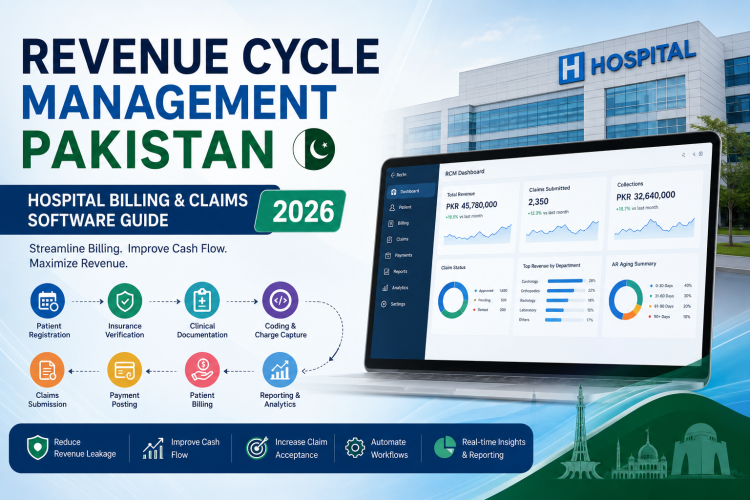
Revenue Cycle Workflow
| Stage | Description | Primary Objective |
|---|---|---|
| Appointment Scheduling | Book patient appointments | Improve patient access |
| Patient Registration | Collect demographics and contact information | Maintain accurate patient records |
| Insurance Verification | Validate insurance eligibility and benefits | Prevent claim rejection |
| Clinical Documentation | Record diagnoses, treatments, and procedures | Support accurate billing |
| Medical Coding | Assign standardized diagnosis and procedure codes | Ensure billing accuracy |
| Charge Capture | Record billable services | Prevent revenue leakage |
| Claim Generation | Create electronic or manual claims | Prepare reimbursement requests |
| Claim Submission | Submit claims to insurance providers or corporate clients | Accelerate payment processing |
| Payment Posting | Record received payments | Maintain financial accuracy |
| Denial Management | Review rejected claims and correct issues | Recover lost revenue |
| Patient Billing | Generate invoices for patient responsibility | Improve collections |
| Accounts Receivable Follow-up | Track outstanding balances | Reduce overdue payments |
| Financial Reporting | Analyze revenue performance | Support business decisions |
Core Components of Revenue Cycle Management
An effective Revenue Cycle Management solution combines several interconnected components that work together to streamline financial operations.
Patient Registration
Accurate patient registration establishes the foundation of the revenue cycle.
Information typically includes:
- Personal details
- Contact information
- CNIC or identification details
- Employer information
- Insurance details
- Corporate affiliations
- Emergency contacts
Accurate registration reduces billing errors and duplicate patient records.
Appointment Scheduling
Efficient scheduling systems improve patient flow while ensuring providers maximize appointment utilization.
Advanced scheduling solutions can:
- Prevent double bookings
- Optimize physician calendars
- Reduce no-show rates
- Send appointment reminders
- Support online booking
Insurance Eligibility Verification
Insurance verification ensures patient coverage is confirmed before services are provided.
Verification helps hospitals:
- Avoid claim rejection
- Improve reimbursement rates
- Inform patients about financial responsibility
- Reduce payment delays
Clinical Documentation
Accurate clinical documentation supports quality patient care while providing the information necessary for correct billing and reimbursement.
Proper documentation includes:
- Diagnoses
- Treatment plans
- Clinical notes
- Laboratory results
- Prescriptions
- Procedures performed
- Discharge summaries
Comprehensive documentation improves coding accuracy and strengthens financial compliance.
Medical Coding
Medical coding translates clinical documentation into standardized diagnosis and procedure codes used for billing and reimbursement.
Accurate coding helps healthcare providers:
- Reduce billing disputes
- Improve reimbursement accuracy
- Generate reliable financial reports
- Support healthcare analytics
As Pakistan’s healthcare sector continues to modernize, standardized coding practices are becoming increasingly important for interoperability and efficient claims processing.
Benefits of Revenue Cycle Management Software in Pakistan
Healthcare organizations across Pakistan are increasingly adopting Revenue Cycle Management (RCM) software to improve financial performance, streamline billing operations, and enhance patient satisfaction. Whether it’s a multi-specialty hospital in Karachi, a diagnostic center in Lahore, or a private clinic in Islamabad, an integrated RCM platform helps healthcare providers optimize every stage of the revenue cycle.
Below are some of the most significant benefits.
1. Improved Revenue Collection
One of the primary goals of Revenue Cycle Management is ensuring that healthcare providers receive the correct payment for every service rendered.
Modern RCM software helps organizations:
- Capture all billable services
- Reduce missed charges
- Eliminate duplicate billing
- Improve invoice accuracy
- Accelerate payment collection
This directly increases hospital revenue while minimizing financial losses.
2. Reduced Revenue Leakage
Revenue leakage occurs when hospitals lose income due to errors, missed charges, coding mistakes, or inefficient administrative processes.
Common causes include:
- Unrecorded procedures
- Incorrect service charges
- Billing omissions
- Duplicate patient records
- Delayed invoice generation
- Manual calculation errors
An automated Revenue Cycle Management system minimizes these risks through validation rules, integrated workflows, and real-time financial monitoring.
3. Faster Billing Process
Manual billing often requires multiple departments to exchange paperwork, verify services, and calculate charges.
With an integrated Revenue Cycle Management solution, billing becomes significantly faster through:
- Automatic charge capture
- Electronic invoice generation
- Integrated billing workflows
- Digital approvals
- Real-time patient account updates
This reduces administrative workload and improves overall operational efficiency.
4. Better Financial Visibility
Hospital executives require accurate financial information to make informed decisions.
RCM dashboards provide real-time insights into:
- Daily collections
- Outstanding balances
- Accounts receivable
- Revenue trends
- Department-wise income
- Insurance claims status
- Patient payment history
- Financial KPIs
These insights enable proactive financial planning and resource allocation.
5. Improved Patient Experience
Patients increasingly expect transparent billing processes and convenient payment options.
A modern Revenue Cycle Management platform improves the patient experience by offering:
- Accurate invoices
- Digital payment methods
- SMS and email billing notifications
- Online payment portals
- Payment installment options
- Clear financial statements
A smoother billing experience builds trust and encourages timely payments.
6. Increased Staff Productivity
Administrative staff often spend considerable time on repetitive tasks such as data entry, invoice preparation, payment reconciliation, and report generation.
Automation enables staff to focus on higher-value responsibilities while reducing manual workload.
Examples include:
- Automatic invoice generation
- Payment reminders
- Financial reconciliation
- Insurance tracking
- Report automation
7. Enhanced Decision Making
Advanced reporting and analytics allow hospital leadership to identify operational inefficiencies before they impact profitability.
Decision-makers can monitor:
- Collection rates
- Average payment turnaround time
- Revenue by specialty
- Top-performing departments
- Outstanding receivables
- Billing accuracy
- Claim rejection trends
Data-driven decision-making improves financial performance across the organization.
Key Features of Modern Revenue Cycle Management Software
An effective Revenue Cycle Management platform combines financial management, billing automation, analytics, and patient engagement into one integrated ecosystem.
Revenue Cycle Management Software Features
| Feature | Benefit |
|---|---|
| Patient Registration | Eliminates duplicate patient records |
| Appointment Scheduling | Improves patient flow |
| Insurance Verification | Reduces claim rejection |
| Medical Coding Support | Improves billing accuracy |
| Charge Capture | Prevents missed revenue |
| Electronic Billing | Accelerates invoice generation |
| Claims Management | Streamlines reimbursement |
| Payment Posting | Updates accounts automatically |
| Accounts Receivable Tracking | Improves collections |
| Denial Management | Recovers lost revenue |
| Patient Payment Portal | Enhances patient convenience |
| Financial Dashboard | Provides real-time KPIs |
| Revenue Analytics | Supports strategic decisions |
| Audit Trail | Improves accountability |
| Multi-Branch Management | Centralizes financial operations |
| Cloud Access | Enables remote management |
| Role-Based Security | Protects sensitive financial data |
| EMR Integration | Connects clinical and financial workflows |
| HIS Integration | Creates a unified hospital ecosystem |
| Automated Reports | Saves administrative time |
Common Revenue Cycle Challenges in Pakistani Healthcare
Although healthcare technology adoption is increasing, many hospitals continue to face financial and operational challenges.
Manual Billing Processes
Many healthcare providers still rely on spreadsheets, handwritten invoices, or disconnected software systems.
This often results in:
- Billing delays
- Human errors
- Duplicate work
- Slow payment collection
Fragmented Healthcare Systems
When EMR, HIS, laboratory systems, pharmacy software, and accounting platforms operate independently, hospitals experience fragmented workflows.
This creates:
- Duplicate data entry
- Communication gaps
- Delayed billing
- Inaccurate reporting
Integrated Revenue Cycle Management solves this challenge by connecting every department.
Coding Errors
Incorrect diagnosis or procedure coding can lead to:
- Billing disputes
- Revenue loss
- Payment delays
- Administrative rework
Regular staff training and standardized coding practices improve reimbursement accuracy.
Delayed Payments
Delayed payments negatively impact hospital cash flow.
Common causes include:
- Late invoice generation
- Missing documentation
- Administrative bottlenecks
- Outstanding patient balances
- Delayed insurance processing
Automation significantly shortens the payment cycle.
Lack of Financial Analytics
Without accurate financial reporting, hospital management struggles to identify:
- Revenue leakage
- Department performance
- Collection efficiency
- Billing trends
Modern dashboards provide actionable financial insights in real time.
Revenue Cycle Management and EMR/HIS Integration
A standalone Medical billing software can only address part of the revenue cycle. Modern healthcare organizations benefit most when Revenue Cycle Management is integrated with Electronic Medical Records (EMR) and Hospital Information Systems (HIS).
Integration ensures that clinical, administrative, and financial data flow seamlessly between departments.
How Integration Improves Revenue Management
Patient Registration
Patient demographic information entered during registration automatically becomes available across all departments, eliminating duplicate data entry.
Clinical Documentation
Doctors document diagnoses, procedures, medications, and treatments directly in the EMR.
This information automatically supports billing and coding without requiring manual transcription.
Laboratory and Radiology Services
Orders placed through the EMR are instantly communicated to laboratory and radiology departments.
Completed investigations automatically update patient records and generate billable charges.
Pharmacy Billing
Prescribed medications dispensed by the pharmacy are automatically added to the patient’s invoice, ensuring accurate charge capture.
Financial Reporting
Hospital executives gain a complete financial overview through unified dashboards that combine clinical and financial performance metrics.
AI and Automation in Revenue Cycle Management
Artificial Intelligence is transforming healthcare finance worldwide, and Pakistani healthcare providers are beginning to adopt AI-driven technologies to improve efficiency.
AI-powered Revenue Cycle Management solutions offer several advantages.
Automated Coding Assistance
Artificial Intelligence can analyze clinical documentation and recommend appropriate diagnosis and procedure codes.
Benefits include:
- Faster coding
- Reduced human error
- Improved billing accuracy
Intelligent Claim Validation
AI systems identify incomplete or incorrect claims before submission, reducing rejection rates.
Validation checks include:
- Missing patient information
- Incorrect procedure codes
- Duplicate claims
- Coverage mismatches
Predictive Revenue Analytics
Machine learning algorithms can forecast:
- Future cash flow
- Collection trends
- High-risk accounts
- Outstanding receivables
These insights support proactive financial planning.
Automated Payment Reminders
RCM platforms can automatically notify patients about:
- Upcoming payments
- Outstanding balances
- Invoice due dates
- Payment confirmations
This improves collection rates while reducing administrative workload.
Fraud Detection
Artificial Intelligence helps identify unusual billing patterns that may indicate:
- Duplicate billing
- Incorrect charges
- Internal fraud
- Financial anomalies
This strengthens compliance and financial governance.
Revenue Cycle Management vs Traditional Billing
Many healthcare organizations in Pakistan still rely on conventional billing methods that involve manual documentation, paper invoices, spreadsheets, and disconnected software applications. While these methods may work for small practices, they often become inefficient as patient volumes increase and healthcare operations grow more complex.
A modern Revenue Cycle Management (RCM) system transforms billing into an end-to-end financial workflow that integrates patient registration, clinical documentation, coding, claims management, payment collection, and reporting.
Revenue Cycle Management vs Traditional Billing
| Feature | Traditional Billing | Revenue Cycle Management |
|---|---|---|
| Patient Registration | Manual | Digital and automated |
| Appointment Scheduling | Separate system or manual | Fully integrated |
| Clinical Documentation | Paper-based or disconnected | Integrated with EMR |
| Charge Capture | Manual | Automatic |
| Medical Coding | Manual | Assisted and standardized |
| Billing | Manual invoice creation | Automated billing workflows |
| Claims Processing | Time-consuming | Electronic and streamlined |
| Payment Tracking | Limited visibility | Real-time tracking |
| Accounts Receivable | Manual follow-up | Automated reminders and dashboards |
| Financial Reporting | Basic reports | Advanced analytics and KPIs |
| Revenue Leakage | Higher risk | Significantly reduced |
| Operational Efficiency | Moderate | High |
| Decision Support | Limited | Data-driven insights |
| Scalability | Difficult | Highly scalable |
Pros and Cons of Revenue Cycle Management
Every technology investment should be evaluated carefully. While Revenue Cycle Management offers substantial financial and operational benefits, healthcare organizations should also consider implementation requirements.
Pros and Cons
| Pros | Cons |
|---|---|
| Improves cash flow | Initial implementation cost |
| Reduces billing errors | Requires staff training |
| Minimizes revenue leakage | Change management may be needed |
| Accelerates payment collection | Data migration from legacy systems |
| Enhances patient satisfaction | Integration planning required |
| Automates repetitive tasks | Dependence on reliable internet for cloud deployments |
| Improves financial reporting | Periodic software updates |
| Supports organizational growth | Workflow redesign during implementation |
| Strengthens accountability | User adoption may take time |
| Enables informed decision-making | Requires ongoing system maintenance |
While implementation requires planning and training, the long-term financial and operational benefits typically outweigh the initial investment.
Estimated Return on Investment (ROI)
Healthcare organizations implementing Revenue Cycle Management often experience measurable improvements in financial performance and operational efficiency.
Potential ROI
| Performance Indicator | Before RCM | After RCM Implementation |
|---|---|---|
| Billing Accuracy | 82% | 98% |
| Claim Acceptance Rate | 78% | 95% |
| Average Payment Collection Time | 45 days | 20–25 days |
| Revenue Leakage | High | Significantly reduced |
| Administrative Workload | High | Reduced through automation |
| Patient Billing Complaints | Frequent | Lower |
| Financial Reporting | Monthly | Real-time |
| Cash Flow Visibility | Limited | Comprehensive |
Actual outcomes vary depending on organizational size, workflow maturity, staff training, and software implementation.
Best Practices for Implementing Revenue Cycle Management
Implementing Revenue Cycle Management is not simply about purchasing software. Success depends on process improvement, staff engagement, and continuous performance monitoring.
1. Standardize Patient Registration
Accurate patient registration forms the foundation of the revenue cycle.
Best practices include:
- Verifying patient identity
- Collecting complete demographic information
- Maintaining updated contact details
- Avoiding duplicate records
2. Improve Clinical Documentation
Accurate documentation supports:
- Proper coding
- Accurate billing
- Reduced claim disputes
- Better clinical outcomes
Healthcare providers should document diagnoses, procedures, medications, and services promptly and consistently.
3. Strengthen Medical Coding
Hospitals should establish standardized coding practices and provide ongoing training to coding teams. Accurate coding minimizes billing errors and improves reimbursement.
4. Automate Billing Workflows
Automation reduces repetitive manual work by:
- Generating invoices automatically
- Posting payments electronically
- Sending payment reminders
- Producing scheduled financial reports
5. Monitor Key Performance Indicators (KPIs)
Hospital leadership should regularly track metrics such as:
- Net collection rate
- Accounts receivable days
- Claim acceptance rate
- Billing turnaround time
- Denial rate
- Revenue per patient
- Outstanding balances
These indicators help identify improvement opportunities and support strategic decision-making.
6. Train Staff Regularly
Technology is only effective when users understand how to use it.
Training should cover:
- Registration procedures
- Billing workflows
- Clinical documentation
- Financial reporting
- System updates
- Compliance requirements
Continuous education promotes consistent performance and reduces operational errors.
How to Choose the Right Revenue Cycle Management Software in Pakistan
Selecting the right solution is a strategic decision. Healthcare organizations should evaluate software based on functionality, scalability, and long-term value.
Essential Evaluation Criteria
Comprehensive Integration
Choose software that integrates with:
- Hospital Information System (HIS)
- Electronic Medical Records (EMR)
- Laboratory Information Systems (LIS)
- Pharmacy Management Systems
- Accounting Software
- Payment Gateways
Automation Capabilities
Look for features such as:
- Automated billing
- Claims management
- Revenue dashboards
- Payment reminders
- Workflow automation
- Real-time reporting
Scalability
The platform should support:
- Multi-branch hospitals
- Multi-specialty clinics
- Diagnostic centers
- Healthcare networks
- Future organizational growth
Security
Financial and patient information should be protected through:
- Role-based access control
- Data encryption
- Audit logs
- Regular backups
- Secure authentication
Reporting and Analytics
Comprehensive dashboards should provide insights into:
- Revenue trends
- Outstanding payments
- Department performance
- Cash flow
- Collection efficiency
- Financial forecasting
Future of Revenue Cycle Management in Pakistan
Pakistan’s healthcare sector is steadily embracing digital transformation, and Revenue Cycle Management will play a central role in this evolution.
Several emerging trends are expected to shape the future:
- Increased adoption of cloud-based healthcare platforms
- Greater use of Artificial Intelligence for billing and analytics
- Predictive financial reporting
- Automated coding assistance
- Enhanced interoperability between healthcare systems
- Expansion of patient self-service portals
- Mobile payment integration
- Advanced business intelligence dashboards
- Improved cybersecurity practices
- Broader adoption among hospitals, clinics, laboratories, and home healthcare providers
As digital healthcare continues to evolve, Revenue Cycle Management will become a strategic capability that supports financial sustainability, operational efficiency, and improved patient experiences.
Frequently Asked Questions (FAQs)
1. What is Revenue Cycle Management?
Revenue Cycle Management is the process of managing the financial journey of a patient, from appointment scheduling and registration to billing, payment collection, and financial reporting.
2. Why is Revenue Cycle Management important for hospitals in Pakistan?
It helps reduce billing errors, improve cash flow, minimize revenue leakage, streamline financial operations, and enhance patient satisfaction.
3. Which healthcare organizations can benefit from RCM?
Revenue Cycle Management is suitable for:
- Hospitals
- Clinics
- Diagnostic laboratories
- Imaging centers
- Specialty practices
- Day surgery centers
- Home healthcare providers
4. Can Revenue Cycle Management integrate with EMR and HIS?
Yes. Modern RCM solutions integrate with EMR, HIS, laboratory systems, pharmacy software, and accounting platforms to create a unified healthcare ecosystem.
5. How does Revenue Cycle Management improve cash flow?
By automating billing, improving charge capture, reducing payment delays, minimizing claim rejections, and strengthening collections.
6. Does Revenue Cycle Management reduce administrative work?
Yes. Automation eliminates many repetitive tasks, including invoice generation, payment posting, reminder notifications, and financial reporting.
7. Is Revenue Cycle Management suitable for small clinics?
Yes. Clinics of all sizes can benefit from improved billing accuracy, faster collections, and better financial visibility.
8. What are the biggest causes of revenue leakage?
Common causes include:
- Billing errors
- Missing charges
- Incorrect coding
- Duplicate records
- Delayed invoicing
- Weak payment follow-up
9. What features should hospitals look for in an RCM solution?
Key features include:
- Patient registration
- Billing automation
- Insurance and claims management
- Accounts receivable tracking
- Financial analytics
- EMR and HIS integration
- Secure payment processing
- Cloud accessibility
10. What is the future of Revenue Cycle Management in Pakistan?
The future includes AI-driven automation, predictive analytics, cloud-based platforms, interoperable healthcare systems, mobile payments, and smarter financial decision-making.
Conclusion
As Pakistan’s healthcare industry advances toward digital transformation, Revenue Cycle Management has become an essential component of sustainable healthcare operations. It is no longer limited to billing and collections but encompasses the entire financial lifecycle of patient care, enabling hospitals, clinics, laboratories, and healthcare networks to improve efficiency, strengthen financial performance, and deliver better patient experiences.
An integrated Revenue Cycle Management solution helps healthcare providers reduce revenue leakage, accelerate reimbursements, automate repetitive administrative tasks, and gain real-time visibility into financial performance. When combined with Hospital Information Systems (HIS), Electronic Medical Records (EMR), Laboratory Information Systems (LIS), and modern analytics, RCM creates a connected ecosystem that supports both clinical excellence and operational success.
Healthcare organizations that invest in modern Revenue Cycle Management software today will be better positioned to improve cash flow, support organizational growth, adapt to changing reimbursement models, and remain competitive in Pakistan’s evolving healthcare landscape.
