
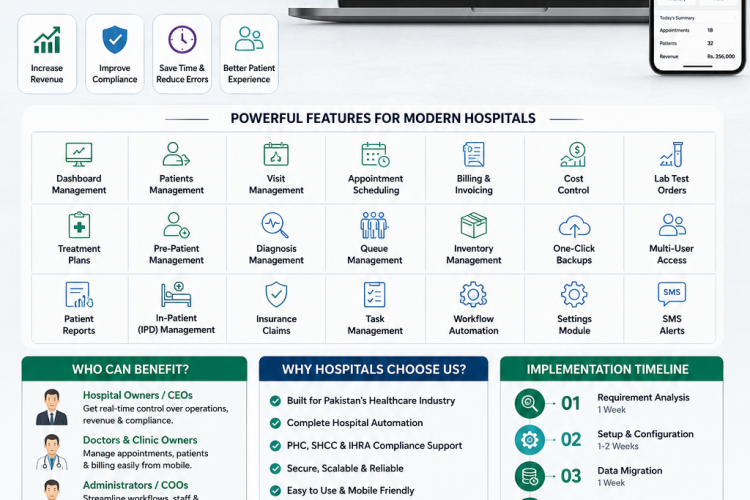
Running a hospital without proper digital systems creates operational chaos. Appointments get missed. Billing errors increase. Insurance claims are rejected. Patient files disappear. Lab coordination becomes slow. Revenue leaks happen silently.
This is where modern hospital software becomes essential.
A reliable hospital management software solution helps hospitals automate operations, improve patient care, reduce manual work, and maintain regulatory compliance in Pakistan. Whether you manage a private hospital, diagnostic center, clinic, or NGO healthcare network, the right software centralizes everything into one system.
Today, healthcare facilities in Pakistan are rapidly shifting toward digital healthcare management because manual systems are too slow, error-prone, and expensive to scale.
What is Hospital Software?
Hospital software is a digital system designed to manage hospital operations from one platform. It handles patient records, appointments, billing, inventory, pharmacy, lab management, insurance claims, reporting, and staff workflows.
In simple words:
Instead of using registers, Excel sheets, paper files, and WhatsApp coordination, hospitals use one centralized platform.
A complete hospital management software in Pakistan usually includes:
- Patient registration
- Appointment scheduling
- Billing and invoicing
- Electronic Medical Records (EMR)
- Pharmacy management
- Laboratory integration
- Inventory tracking
- Staff management
- Insurance claims
- Compliance reporting
The goal is simple:
Save time, reduce mistakes, increase revenue visibility, and improve patient experience.
Why Hospital Software Matters
Healthcare operations in Pakistan face serious operational challenges.
Common Problems Hospitals Face
| Problem | Impact |
|---|---|
| Manual billing errors | Revenue leakage |
| Lost patient files | Poor patient care |
| Delayed reports | Patient dissatisfaction |
| Inventory mismanagement | Medicine expiry losses |
| Insurance claim rejection | Financial losses |
| No real-time dashboard | Poor decision making |
| Staff coordination issues | Operational delays |
| Compliance reporting problems | Regulatory risks |
A modern hospital admin software solves these problems through automation and centralized workflows.
Real-Life Benefits
For Hospital Owners
- Real-time revenue visibility
- Better operational control
- Reduced administrative overhead
- Compliance-ready reporting
For Doctors
- Quick patient history access
- Faster diagnosis workflow
- Simplified appointment management
For Finance Teams
- Automated invoicing
- Insurance claim tracking
- Accurate financial reporting
For Labs & Pharmacies
- Digital test workflows
- Inventory alerts
- Faster communication with doctors
Features of Hospital Management Software in Pakistan
Dashboard Management
A centralized dashboard gives management complete visibility into hospital performance.
Benefits
- Revenue tracking
- Expense monitoring
- Staff productivity insights
- Occupancy reports
- Daily patient statistics
Hospital owners can make faster decisions with real-time analytics instead of waiting for manual reports.
Patients Management
Patient management modules store complete digital records securely.
Features
- Digital patient profiles
- Medical history tracking
- Prescription records
- Visit history
- Document uploads
Benefits
- Faster patient handling
- Improved care continuity
- Reduced paperwork
Visit Management
This module tracks every patient interaction.
Includes
- Consultation records
- Follow-up visits
- Admission tracking
- Doctor notes
It helps hospitals maintain accurate treatment history.
Appointment Scheduling
Appointment scheduling eliminates manual phone coordination.
Key Benefits
- Online bookings
- SMS reminders
- Reduced no-shows
- Better doctor scheduling
This is especially useful for clinics and specialist doctors.
Billing & Invoicing
Billing mistakes directly impact hospital profitability.
Modern hospital management software automates:
- Invoice generation
- Tax calculations
- Insurance billing
- Payment tracking
Results
- Reduced billing errors
- Faster payments
- Transparent accounting
Cost Control
Hospitals lose significant revenue due to poor expense tracking.
Cost control modules help by:
- Tracking departmental spending
- Monitoring procurement
- Identifying unnecessary expenses
Lab Test Orders
Laboratory integration improves diagnostic workflows.
Features
- Digital test requests
- Result uploads
- Doctor notifications
- Report tracking
Benefits
- Faster diagnostics
- Reduced paperwork
- Improved accuracy
Treatment Plans
Doctors can create structured treatment plans digitally.
Benefits
- Better treatment consistency
- Easier patient monitoring
- Improved coordination between departments
Pre-Patient Management
Pre-registration helps reduce front-desk congestion.
Includes
- Online registration
- Appointment confirmation
- Initial patient data collection
Diagnosis Management Module
This module helps doctors maintain organized diagnostic records.
Features
- Clinical notes
- Diagnosis tracking
- Prescription integration
- Lab correlation
Queue Management
Queue systems improve patient experience significantly.
Benefits
- Reduced waiting confusion
- Better patient flow
- Improved operational efficiency
Inventory Management
Inventory losses are a major issue in Pakistani hospitals.
Inventory Modules Track
- Medicines
- Surgical items
- Medical equipment
- Expiry dates
- Low-stock alerts
Benefits
- Reduced wastage
- Better procurement planning
- Lower operational losses
One-Click Backups
Data loss can destroy hospital operations.
One-click backup systems provide:
- Automatic backups
- Secure recovery
- Cloud storage options
Multi-User Access
Different departments require different permissions.
Role-Based Access
- Doctors
- Finance teams
- Reception staff
- Pharmacists
- Administrators
This improves security and workflow control.
Patient Reports
Hospitals need structured reporting systems.
Reports Include
- Medical history
- Billing reports
- Lab reports
- Admission summaries
In-Patient (IPD) Management
IPD management handles admitted patient workflows.
Features
- Bed allocation
- Nursing notes
- Treatment tracking
- Discharge summaries
Insurance Claims
Insurance handling in Pakistan is becoming increasingly important.
Insurance Features
- Claim submission
- Approval tracking
- Rejection monitoring
- Automated documentation
Benefits
- Faster reimbursements
- Lower rejection rates
Task Management Software
Hospitals involve multiple teams working simultaneously.
Task management systems help:
- Assign responsibilities
- Monitor task completion
- Improve accountability
Workflow Automation
Automation reduces repetitive manual work.
Automated Processes
- Billing
- Appointment reminders
- Inventory alerts
- Lab notifications
This increases operational efficiency.
Settings Module
Admin settings allow hospitals to customize:
- Departments
- Staff permissions
- Billing rules
- Notification settings
SMS Alerts
SMS systems improve communication.
Use Cases
- Appointment reminders
- Billing notifications
- Test result alerts
- Follow-up reminders
Regulatory Compliance in Pakistan
Healthcare regulations in Pakistan are becoming stricter.
Hospitals must comply with:
- PHC standards
- SHCC regulations
- IHRA compliance
- Data privacy requirements
- Financial reporting standards
A reliable hospital management software in Pakistan helps generate compliance-ready reports automatically.
This reduces audit stress and administrative burden.
Pricing & Plans
One of the biggest mistakes healthcare software providers make is hiding pricing completely.
Hospitals need clarity.
Typical Pricing Models
| Plan Type | Best For | Estimated Pricing |
|---|---|---|
| Basic Clinic Plan | Small clinics | Monthly subscription |
| Mid-Size Hospital Plan | 20-100 bed hospitals | Custom pricing |
| Enterprise Hospital Plan | Large hospital groups | Scalable enterprise pricing |
What Affects Pricing?
- Number of users
- Hospital size
- Modules required
- Cloud vs on-premise deployment
- Multi-branch support
- Custom integrations
Important Reality
Cheapest software usually becomes expensive later because:
- Support is poor
- Features are incomplete
- Scaling becomes difficult
Hospitals should evaluate long-term operational value, not just initial pricing.
Free Trial & Demo Access
Most hospitals hesitate because implementation feels risky.
That is why modern healthcare platforms should offer:
- Free trial access
- Live demos
- Sandbox testing
- Staff onboarding sessions
Low-friction onboarding increases buyer confidence significantly.
Comparison Table. Hospital Software Options
| Feature | Basic Software | Mid-Level HMS | Advanced Enterprise HMS |
|---|---|---|---|
| Appointment Management | Yes | Yes | Yes |
| EMR Integration | Limited | Full | Full |
| Insurance Claims | No | Partial | Advanced |
| Inventory Tracking | Basic | Advanced | Enterprise |
| Multi-Branch Support | No | Limited | Yes |
| Compliance Reporting | No | Partial | Advanced |
| Analytics Dashboard | Basic | Advanced | AI-driven |
| Mobile Access | Limited | Yes | Yes |
| Data Migration Support | No | Limited | Dedicated |
Pros and Cons of Hospital Management Software
| Pros | Cons |
|---|---|
| Reduces manual errors | Initial staff training required |
| Improves revenue tracking | Setup cost can be high |
| Better patient management | Poor vendors create implementation issues |
| Faster billing workflows | Data migration takes planning |
| Improves compliance reporting | Requires internet stability for cloud systems |
How to Choose the Right Hospital Management Software
Choosing the wrong system creates operational disasters.
Step 1. Define Your Hospital Size
Different hospitals need different systems.
Small Clinics
Need:
- Appointment management
- Billing
- Basic EMR
Mid-Size Hospitals
Need:
- IPD management
- Insurance workflows
- Inventory systems
Large Hospital Networks
Need:
- Multi-branch control
- Advanced analytics
- Enterprise security
Step 2. Check Ease of Use
If staff cannot learn it quickly, implementation fails.
Look for:
- Simple dashboard
- Mobile accessibility
- Easy workflows
Step 3. Verify Compliance Features
Pakistani healthcare compliance requirements are increasing.
The software should support:
- PHC reporting
- SHCC compliance
- Audit readiness
Step 4. Ask About Data Migration
Many hospitals already have years of patient data.
Ask vendors:
- Can old data be imported?
- How long does migration take?
- Will downtime happen?
This is critical.
Step 5. Evaluate Support Quality
Bad support destroys operations.
Check:
- Response times
- Training availability
- 24/7 support access
Best Use Cases. Who Should Use Hospital Software?
? Hospital Owner / CEO
Main Problems
- No operational visibility
- Revenue tracking issues
- Audit fears
What They Need
- Real-time dashboard
- Financial transparency
- Compliance automation
???? Specialist Doctor / Clinic Owner
Main Problems
- Appointment chaos
- Missing patient records
- Billing mistakes
What They Need
- Mobile-friendly system
- Easy scheduling
- Affordable subscription model
?? Trust / Foundation Hospital Head
Main Problems
- Donor reporting challenges
- Manual compliance reports
- Staff accountability issues
What They Need
- Compliance reporting
- Multi-branch management
- Transparent financial systems
? Hospital Administrator / COO
Main Problems
- Staff onboarding concerns
- Downtime risks
- Workflow disruptions
What They Need
- Easy implementation
- Staff training
- Reliable migration support
? Finance / Accounts Manager
Main Problems
- Insurance claim rejection
- Manual reporting
- Billing errors
What They Need
- Automated invoicing
- Revenue dashboards
- Claim management systems
? Lab / Pharmacy In-Charge
Main Problems
- Expired stock
- Delayed reports
- Manual communication
What They Need
- Inventory alerts
- Digital lab reporting
- Integrated workflows
Implementation Timeline
Hospitals constantly underestimate implementation complexity.
Typical Timeline
| Stage | Duration |
|---|---|
| Requirement Analysis | 1 Week |
| Setup & Configuration | 1-2 Weeks |
| Data Migration | 1 Week |
| Staff Training | 3-7 Days |
| Go Live | 1-3 Days |
A realistic rollout plan reduces operational disruption.
Data Migration Support
This is one of the biggest buyer concerns.
Hospitals fear:
- Losing historical records
- Downtime during migration
- Corrupted patient data
Reliable vendors provide:
- Secure migration process
- Backup verification
- Testing before launch
- Zero-data-loss approach
Without migration support, implementation risk becomes very high.
Video Demo & Product Walkthrough
Static screenshots are not enough anymore.
Hospitals want:
- Live dashboard walkthroughs
- Billing flow demonstrations
- Mobile app previews
- Real workflow examples
A short product demo drastically improves conversion because buyers can visualize operations before purchase.
Why Choose Itack Solutions
Itack Solutions provides healthcare-focused digital systems designed for hospitals, clinics, labs, and healthcare networks in Pakistan.
Key Advantages
- Local healthcare industry understanding
- Customizable workflows
- Compliance-focused development
- EMR and HMIS expertise
- Ongoing support and training
- Scalable architecture
Business Benefits
- Reduced operational inefficiencies
- Better patient experience
- Faster billing cycles
- Improved reporting accuracy
- Centralized healthcare operations
Unlike generic software vendors, healthcare-focused providers understand the operational complexity of hospitals.
Common Mistakes to Avoid
Choosing Cheap Software Only
Low-cost systems usually create:
- Scaling limitations
- Security problems
- Poor support quality
Ignoring Staff Training
Even good software fails without proper onboarding.
Not Planning Data Migration
Migration should never be treated as an afterthought.
Buying Unnecessary Features
Many hospitals overpay for modules they never use.
Choose based on operational requirements.
Ignoring Compliance Requirements
Non-compliant systems create future legal and operational risks.
Conclusion
The healthcare industry in Pakistan is rapidly digitizing. Hospitals relying on paper records and disconnected systems will struggle with operational efficiency, compliance requirements, and patient expectations.
A modern hospital software solution helps healthcare providers automate workflows, reduce billing errors, improve patient care, strengthen reporting, and gain real-time operational control.
The right hospital management software is not just an expense. It is an operational infrastructure investment.
Hospitals that implement digital systems correctly usually experience:
- Better efficiency
- Faster reporting
- Improved patient satisfaction
- Stronger financial control
If you are evaluating the best hospital management software in Pakistan, focus on usability, compliance, support quality, scalability, and long-term operational value instead of only comparing pricing.
FAQs
What is hospital management software?
Hospital management software is a digital system that helps hospitals manage appointments, billing, patient records, inventory, insurance claims, and operational workflows from one platform.
Which hospital software is best in Pakistan?
The best solution depends on hospital size, operational complexity, and compliance requirements. Hospitals should evaluate scalability, support, integrations, and reporting features before selecting software.
Is hospital management software suitable for small clinics?
Yes. Small clinics can use lightweight systems for appointment scheduling, billing, EMR management, and patient tracking.
How much does hospital software cost in Pakistan?
Pricing depends on hospital size, modules required, number of users, and deployment type. Most providers offer subscription-based or custom enterprise pricing.
Can old hospital data be migrated into new software?
Yes. Most professional healthcare software providers offer data migration services to transfer existing patient and financial records securely.
Does hospital software support insurance claims?
Advanced hospital management systems include insurance claim submission, tracking, and reimbursement management modules.
How long does implementation take?
Small clinics may go live within days, while large hospitals usually require several weeks for setup, migration, training, and deployment.
